
Views: 16
The autonomous taxi market continues to grow, and new players with different proposals are constantly emerging. The latest to join this race is Lucid Motors, a startup seeking to carve out a niche by betting on an unusual approach: simplifying the vehicle as much as possible.
Their proposal is called “Lunar,” an electric car specifically designed to function as a robotaxi. And the first thing that catches the eye is its radical approach: only two passenger seats.
According to Lucid, most urban journeys are made with one or two passengers. So, why design larger, heavier, and more expensive vehicles?
Reducing the number of seats is not just a design decision. It has direct implications:
. Less weight
. Lower energy consumption
. Greater range
. Lower manufacturing costs
In an electric vehicle, every kilogram counts. The lighter the car, the less battery power it needs to deliver good performance. And that, in a business like autonomous taxis, can make all the difference.
The Lunar was unveiled in New York last March at Investor Day, which is no small detail. Beyond the technological development, these kinds of initiatives also seek to attract media attention and investors. Lucid is a relatively young company: founded in 2007, but with a real market presence since 2021 with its luxury sedan, the Lucid Air.
Its sales figures are still modest—fewer than 16,000 units in 2025—which makes projects like this a way to position itself in a sector with enormous potential.
Currently, operating autonomous taxi services, like Waymo, use relatively large vehicles with capacity for four or more passengers.
The Lunar breaks with that logic. It's small, lightweight, and focused on individual or couples' journeys. During its presentation, a doorless version was even shown, designed to highlight the simplicity of the interior design. A concept that's more reminiscent of a futuristic urban vehicle than a traditional taxi.
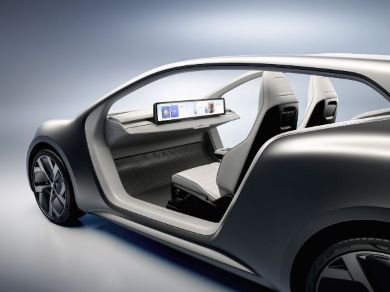
One of Lucid's most striking arguments is that its robotaxi could reduce costs by up to 40% compared to current alternatives, such as those from Waymo.
On paper, it makes sense: fewer materials, less battery, less complexity. But in practice, many factors come into play: maintenance costs, software, regulations, insurance, and, above all, the reliability of the autonomous system.
For now, that promise remains a hypothesis, and this is a huge challenge for a small company. Entering the autonomous taxi market is not easy. It requires significant investment, advanced technology, and, above all, time.
Large companies have been developing these systems for years, with billions invested. For a company like Lucid, the challenge is considerable.
However, its unique approach could work in its favor. Instead of competing directly with giants, it's trying to open a new, more efficient and economical category.
The Lunar concept is, for now, just that: a concept car. An idea that points toward a possible evolution of urban transportation. The key question is whether the market will accept this type of smaller, more specialized vehicle. And whether the cost savings will be enough to compensate for its limitations.
As is often the case in technology, it's not always the most powerful vehicle that wins, but rather the one best suited to real-world use.
We'll have to see if this minimalist approach manages to gain traction in a sector that could undoubtedly help define the future of transportation.
 EN
EN  ES
ES