
Views: 19
For decades, robots have been extremely efficient machines… but also limited. They performed repetitive tasks with pinpoint accuracy, yes, but always within a pre-programmed script. Outside of that script, they simply didn't know what to do.
That paradigm is changing. And it's doing so thanks to artificial intelligence. The recent collaboration between Boston Dynamics and Google DeepMind marks an interesting turning point: we are moving from robots that execute orders to robots that interpret, reason, and decide.
Classic robots operate like a chain of instructions: “if A happens, do B.” This is useful in controlled environments, such as factories, but insufficient in complex or changing scenarios.
This is where the new AI model called Gemini Robotics-ER 1.6 comes in. This system not only processes data but also interprets the visual environment and makes decisions in real time. In other words: it's starting to resemble how a human being acts more closely.
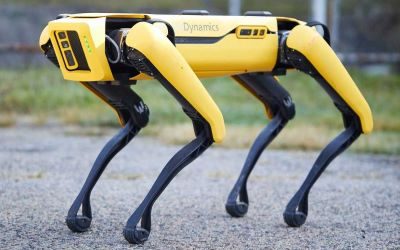
Boston Dynamics' quadruped robot—very similar to the well-known Spot—can now analyze what it sees, detect anomalies, and act accordingly. It doesn't just execute; it understands.
One of the most significant advances is the so-called "vision agent." This system combines visual perception with logical reasoning and code execution.
A robot can navigate an industrial facility, read indicators, detect deviations, and generate reports without human intervention. Something that previously required specialized operators can now be automated with greater flexibility.
Furthermore, this system achieves accuracy levels close to 90% in interpreting its environment. It's not perfect, but it's already sufficiently useful for many real-world applications, and it will continue to improve in the future.
This is a profound shift in robotics. This advancement isn't incremental; it's structural. The integration of AI into robots completely transforms their role:
. From rigid tools to adaptive systems
. From mechanical execution to understanding the environment
. From human dependence to supervised autonomy
And this opens the door to new uses: industrial maintenance, advanced logistics, technical inspections, and even assistance in hazardous environments. A market with enormous potential
The union of robotics and artificial intelligence is one of the sectors with the greatest economic potential. Not only because of improved efficiency, but also because it allows us to tackle tasks that were previously unfeasible or too costly.
For companies like Boston Dynamics, this evolution multiplies the value of their robots. And for Google DeepMind, it means taking its technology beyond the digital world into the physical world. It's a clear symbiosis: one provides the "body," the other the "brain."
How far can this go? Here, it's wise to exercise caution. Although the advances are remarkable, we are still far from robots with general intelligence comparable to human intelligence.
Reasoning in controlled environments is one thing. Adapting to the complexity of the real world is quite another. Even so, the direction is clear: each new generation will be more autonomous, more flexible, and more useful.
The collaboration between Boston Dynamics and Google DeepMind isn't just another tech news story. It's a sign of where we're headed: machines that not only perform tasks but also begin to understand.
And when that happens, the impact isn't just industrial. It's social, economic… and profoundly transformative.
A video can be seen at: https://www.youtube.com/watch?v=kBwxmlI2yHQ
 EN
EN  ES
ES