
Views: 16
Large data centers have become the major technological infrastructures of our time. They are veritable “digital factories” where the information that drives today’s economy is processed, especially with the rise of artificial intelligence.
However, these giants have a significant problem: their rigidity. Building a traditional data center can take more than three years, requiring enormous investments and offering little capacity to adapt to rapid changes in demand.
In a world where technology is advancing at breakneck speed, this lack of flexibility is becoming a hindrance. And a new alternative is emerging.
This is where modular data centers come into play. These are prefabricated units—often the size of a shipping container, around 15-20 meters—that can be manufactured on-site and transported by truck to their final destination.
Companies like LG, Hewlett Packard Enterprise, and others are already betting on this model, which allows for much faster deployment of computing power. The idea is simple yet powerful: build in pieces, like technological LEGO bricks.
Speed and scalability are key advantages. One of the biggest attractions of these systems is deployment time. While a conventional data center can take years to become operational, a modular one can be installed in as little as six months.
But the most interesting aspect is its scalability. If a company needs more computing power, it simply adds new modules. If demand drops, it doesn't have to maintain oversized infrastructure.
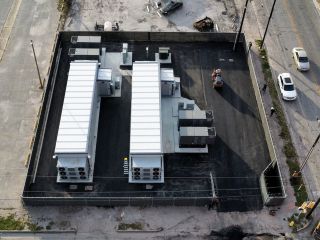
This approach fits perfectly with the explosive growth of artificial intelligence, where computing needs can change in a matter of months.
Current data centers house thousands of GPUs, essential for training and running AI models. However, the inference phase is becoming increasingly important: when the already trained models respond to users in real time with less computing power.
This is where modular data centers can find a particularly interesting niche. They allow for the deployment of capacity close to the end user, reducing latency and improving the user experience. Furthermore, being more compact and efficient, they can adapt better to distributed scenarios, moving away from the traditional centralized model.
Forecasts indicate that the modular data center market could double by 2030. This is no coincidence: the demand for computing power continues to grow unabated.
In addition, factors such as energy consumption and sustainability are driving the search for more efficient solutions. Prefabricated modules allow for better optimization of cooling and energy use from the initial design stage.
Although the idea is attractive, it will not completely replace large, traditional data centers. These will still be necessary for large-scale operations, especially for training AI models.
However, modular data centers offer something the classic model lacks: agility. In an environment where technology is constantly changing, being able to deploy infrastructure in months instead of years is a huge competitive advantage.
Everything points to increased adoption in the coming years. The key will be seeing how the market responds and whether it truly meets expectations in terms of cost, performance, and reliability.
But one thing is clear: in the age of artificial intelligence, flexibility is no longer a luxury. It's a necessity.
 EN
EN  ES
ES