
Views: 16
In recent years, drones have gone from being a technological curiosity to becoming a key element in modern conflicts. We are seeing this clearly in the war in Ukraine and, more recently, in tensions in the Middle East: drones are now protagonists on the battlefield.
And there is an obvious problem: defending against them is neither easy nor cheap, because they are a versatile and constantly evolving weapon. Current drones cover a vast spectrum of applications: surveillance and reconnaissance, electronic warfare, direct attacks, autonomous or coordinated missions, etc …
Some are large and sophisticated, comparable to unmanned aerial vehicles controlled from thousands of kilometers away. But the real change has come from small, cheap, and ubiquitous drones. These devices, often low-cost, can carry explosive payloads and attack high-value targets. Their advantage is clear: they cost very little and can cause significant damage.
Herein lies one of the great paradoxes of modern warfare. A drone can cost a few thousand dollars. Shooting it down with a traditional system—like an advanced missile—can cost hundreds of thousands or even millions. This is a clear imbalance.
Furthermore, drones can be produced in large quantities, even hundreds a day. In contrast, advanced defense systems require time, materials, and a complex industrial chain. The result is a scenario where attacking is cheap and defending is expensive.
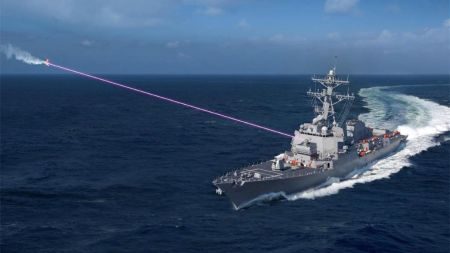
To solve this problem, military powers are investing in more efficient systems based on directed energy: high-energy lasers and high-power microwaves.
These systems do not use projectiles. Instead, they emit energy capable of damaging the drone's electronics or destroying its structure. Lasers, in particular, are advancing rapidly. Their major advantage is that the "firing" has a very low cost compared to a missile. It's the cost of the energy required.
[Image: Boat and laser] However, they are not a perfect solution because shooting down a drone with a laser is not as simple as it seems. To disable it, it is necessary to keep the energy beam focused on a specific point on the drone for several seconds. And that, against a small, fast, and moving object, is no trivial task.
Furthermore, factors such as weather conditions, distance, and system stability directly influence the system's effectiveness. Therefore, although promising, these systems are still in the development and gradual deployment phase.
What we are seeing is a new cycle in military evolution:
. A disruptive technology emerges (drones)
. Countermeasures are developed (lasers, microwaves, etc.)
. New tactics are created to overcome these defenses
And the cycle repeats.
Major powers are already investing enormous resources in improving their drone defense systems, seeking cheaper, faster, and more scalable solutions. Because the reality is clear: drones are not going away.
Drones have changed the rules of the game. They are cheap, effective, and difficult to neutralize. Defending against them requires new technologies and large investments. The future points to directed energy systems as a solution, but there is still a long way to go.
Behind all this technological evolution lies an uncomfortable reflection. After thousands of years of history, we continue to invest enormous resources in perfecting how to confront one another. Technology advances, but conflicts persist. And although innovation can make war more “efficient,” it does not make it more reasonable.
 EN
EN  ES
ES