
Views: 22
For decades, designing a car, an airplane, or any complex product was a long, expensive, and largely sequential process. First, a 3D model was created, then experts analyzed its behavior—for example, aerodynamics—and, weeks or even months later, results were obtained. Only then were physical prototypes manufactured to validate everything in the real world.
Today, that approach is changing radically thanks to artificial intelligence.
We are moving from slow testing to intelligent prediction. The major transformation comes from what are known as AI-based physical models or large physics models. Instead of simulating each scenario from scratch, these models learn from enormous amounts of data from previous designs.
This means they can predict complex behaviors—such as airflow, drag, or energy efficiency—in a matter of minutes or less.
Companies like PhysicsX are already applying this approach, offering tools capable of drastically reducing design times. Major manufacturers like General Motors are beginning to integrate these solutions into their processes.
AI-assisted design: faster, but also smarter. The key isn't just speed. These systems allow for the exploration of thousands of design variations that were previously unfeasible due to cost or time constraints.
For example: Optimizing a car's shape to reduce fuel consumption, adjusting an airplane's wings to improve efficiency, designing lighter and stronger structures, etc …
Here's where another fundamental element comes into play: the ability to customize. Companies train these models with their own historical data, allowing them to capture their "design DNA."
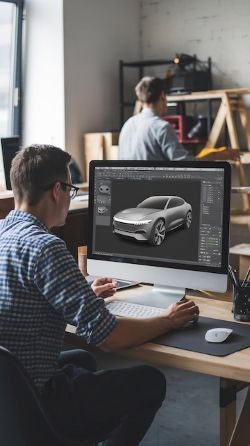
When discussing artificial intelligence, one name constantly emerges: NVIDIA. In this field, this company has taken a significant step with platforms like physicsNEMO, an open-source initiative that combines physics simulation and machine learning. This type of tool is accelerating the adoption of AI in industrial sectors.
The speed at which this ecosystem is moving is remarkable: new solutions, new integrations, and continuous improvements are redefining how products are designed.
Are engineers disappearing? Quite the opposite. A key point to clarify: these tools don't replace experts; they make them more necessary.
AI models are sophisticated, but they require engineers capable of training them correctly, experts to interpret the results, and professionals to validate critical decisions. The work is changing, yes. But it's becoming more strategic and adding more value.
This is a structural change in the industry. And what we're seeing isn't just a technological improvement, but a paradigm shift.
Before:
Design → simulation → prototype → validation
Now:
Design + real-time prediction → rapid iteration → optimized validation
The result is clear: Less development time, lower costs, and more efficient products. This approach isn't limited to cars or airplanes. It's spreading to sectors like energy, construction, and even medicine.
The combination of data, physical models, and computing power is creating a new way to innovate: faster, more precise, and more connected to reality.
The conclusion is simple: artificial intelligence is not only changing how we design, but also how we think about design.
 EN
EN  ES
ES