
Views: 32
Some aircraft transcend their military function and become icons. The UH-60 Black Hawk (manufactured by Sikorsky Aircraft, now a division of Lockheed Martin) is undoubtedly one of them. Since entering service in the late 1970s, this helicopter has flown over conflicts, humanitarian missions, and special operations in every corner of the globe. More than 5,000 units manufactured attest to its history.
The Black Hawk is a legend that is retiring. It has already surpassed 40 years of service, and although it continues to be manufactured and remains a remarkable military asset, its retirement is beginning to appear on the horizon.
Its merits are undeniable. With a cruising speed of 262 km/h, a capacity to transport up to 11 soldiers, and a versatility that has taken it to virtually every theater of operations, it became famous during the Vietnam War. A machine that defined an era, but technology waits for no one.
History moves on. And the U.S. Army has already chosen its successor. The Bell V-280 has arrived: helicopter and airplane in one.
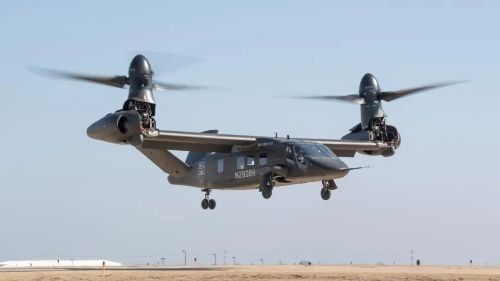
The Future Long-Range Assault (FLRAA) program to replace the famous UH-60 Black Hawk has a winner: the Bell V-280. And it's not a conventional helicopter. It's a tiltrotor tiltrotor aircraft, meaning it takes off and lands like a helicopter, but once airborne, it rotates its rotors 90 degrees and flies like an airplane.
The Bell V-280 can carry a crew of four along with 14 troops, reaches a cruising speed of 520 km/h (350 mph), and has a range of 3,900 kilometers (2,000 miles), twice that of the most modern Black Hawk helicopters. The numbers speak for themselves: more speed, more range, more capability.
It's an idea that took decades to mature. This type of technology didn't appear overnight. The first experiments with tiltrotors began more than thirty years ago with the V-22 Osprey, used by the Marines. There were technical problems, accidents, and a lot of skepticism. But perseverance prevailed.
.
The V-280 is the second generation of that idea, refined and improved. The V-280 made its first flight on December 18, 2017, in Amarillo, Texas. Since then, the program has progressed steadily.
A significant new development arrived in 2025. In May 2025, the U.S. Army announced the official military designation of the V-280: MV-75. The M stands for multi-purpose aircraft and the V for tiltrotor aircraft. The 75 pays homage to the year the U.S. Army was founded, 1775.
More recently, the Army announced that the MV-75's nickname would be "Cheyenne II," following the tradition of naming its helicopters after Native American tribes, in honor of the Cheyenne tribe, known for their adaptability and warrior spirit.
A name with significant historical weight for an aircraft that aspires to shape the future. The program is progressing very well and could be ready for mass production ahead of schedule. Limited user testing is planned for 2027-2028, with the first operational deployment expected with the 101st Airborne Division, the first to operate it.
The total value of the program, taking into account the aircraft's service life, could reach $70 billion. The largest investment in helicopters by the U.S. military in more than four decades.
One chapter closes, another begins. Aviation enthusiasts will never forget the Black Hawk. It's one of those aircraft that leaves a lasting impression. But the MV-75 Cheyenne II arrives to demonstrate that the best ideas, when developed with patience and rigor, end up changing the world.
Or in this case, the skies.
 EN
EN  ES
ES