
Views: 32
Hello to all sky and technology enthusiasts! Today we're going to travel back in time and, at the same time, land in the near future. When we think of airplanes, the classic image immediately comes to mind: an elongated body and two flat wings on the sides. This design has been with us since the Wright brothers patented their "flying machine" in 1906. However, what if I told you that the future of aviation could have curves?
Because there's an old concept that's now taking off. The idea of "semicircular wings" isn't new. Decades ago, visionary engineers already sketched these curved shapes, seeking an efficiency that straight wings couldn't provide. But there was a problem: back then, the technology didn't allow for controlling such a complex machine in the air. They were unstable designs for the analog systems of the time.
But, as with the best ideas, they just needed the right moment. That moment is now. Thanks to digitalization and state-of-the-art flight control systems, what was once an unattainable dream is now a tangible reality called “Cyclone.”
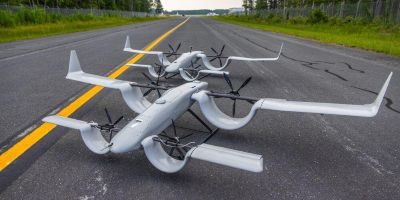
The company HopFlyt has taken this concept and elevated it to the next level. Its prototype, the Cyclone, is a marvel of modern engineering. What makes it special is its hybrid configuration: it combines fixed, flat wings with semicircular sections that house propellers inside.
This structure isn't just for aesthetics. The semicircular section can pivot, allowing the aircraft to take off vertically, like a helicopter, and then transition to fast and efficient horizontal flight. This is what we know as a VTOL (Vertical Take-Off and Landing).
The advantages are clear and very promising for urban and interurban mobility:
. Goodbye to runways: By taking off vertically, it doesn't need conventional airports. A small helipad or flat surface is sufficient.
. Low-speed maneuverability: Unlike traditional aircraft, the Cyclone moves with astonishing stability at low speeds, something vital for safety.
. Sustainability and versatility: Its four propellers can be powered by electric motors or hybrid systems, opening the door to much cleaner aviation.
Although an operational prototype is already conducting test flights (you can see its technology in action on its official website), there are still some unknowns. Experts are eager to learn more precise data about its actual power, energy consumption, real-world range, etc.
You can see the company's website at: https://hopflyt.com/
Without a doubt, we are witnessing one of the most interesting and innovative developments in recent aeronautics. Semicircular wings have gone from being a historical curiosity to becoming a potential key to a new era in a segment of transportation.
A video can be viewed at: https://www.youtube.com/watch?v=9PjR0wXq-yY
We'll be keeping a close eye on this technological "cyclone," and we wish them all the best.
 EN
EN  ES
ES