
Views: 23
For more than a century, cars have used virtually the same braking principle: a hydraulic system. When the driver presses the brake pedal, a piston generates pressure on a fluid that travels through pipes to the calipers or brake shoes on the wheels. There, this mechanical pressure is transformed into friction, and the car stops.
It's a robust, reliable, and universal system. But the digital revolution in the automotive industry has now reached brakes as well. The Italian company Brembo has just taken a very important step with its new "brake-by-wire" system, called Sensify. And everything points to this being another of the biggest technical transformations in the modern automobile.
Goodbye to brake fluid. The great innovation of Sensify is that it almost completely eliminates the traditional hydraulic system. There is no longer a fluid circuit running through the car or a large central pressure system.
Now, when the driver steps on the brake pedal, the action is converted into a digital signal. This information travels through cables to a central computer that calculates precisely how much each wheel should brake. Then, small electric motors located at each wheel directly activate the brake calipers.
In other words, braking is no longer dependent on hydraulic pressure but is controlled by software. It may sound futuristic, but it actually follows the same evolution that other automotive systems have already undergone, such as electric power steering and electronic accelerators.
The great advantage of this system is not simply the elimination of mechanical components. What is truly revolutionary is that each wheel can brake independently and with enormous precision.
The computer can decide in milliseconds how much to brake each wheel based on the road surface, speed, vehicle lean, or even the driver's style. On wet roads, ice, or in emergency situations, this could significantly improve stability and safety.
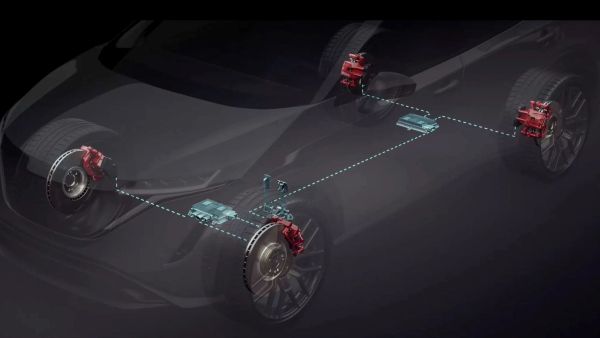
Brembo has already confirmed that Sensify has entered production for a global manufacturer, although it has not yet revealed the name of the first brand to incorporate it.
Another interesting aspect is that the system can be updated remotely. Just as a mobile phone receives new features via the internet today, manufacturers will be able to improve the braking performance of their cars through over-the-air updates.
This opens the door to new possibilities: personalized driving modes, different pedal responses, safety improvements, and integration with autonomous driving systems.
We must consider that this type of technology fits perfectly with the new electric and autonomous cars, where almost everything already depends on software and electronic sensors.
All of this aligns with an increasingly evident trend: the automobile is becoming a digital platform. A kind of computer on wheels. In a few years, many cars could be technically reduced to four wheels, a battery with its charging management system, electric motors, and several interconnected control computers.
And here, the most controversial debate also arises. Manufacturers could activate or limit functions via software: engine power, acceleration capabilities, driving modes, or even safety features. Something similar to apps or subscriptions on mobile phones.
Algunas marcas como Mercedes ya exploran modelos donde determinadas funciones o mejoras se desbloquean pagando cuotas adicionales.
Personally, this technological evolution is fascinating from a technical standpoint, but it also raises important questions. Car owners could become increasingly dependent on the manufacturer to maintain, update, or even use certain functions of their vehicle.
The future of the automobile may be smarter, safer, and more efficient. But it could also be much more controlled.
And as always with major technological revolutions, only time will tell.
 EN
EN  ES
ES