
Views: 26
Artificial intelligence no longer just wins chess matches or dominates complex video games. Now it's also starting to excel in the physical world. And one of the most surprising examples in recent months is a robot capable of playing table tennis at a professional level… and even beating human experts.
The robot is called Ace and was developed by Sony AI. Its research has been published in the prestigious scientific journal Nature, confirming the enormous technological significance of this advance.
Furthermore, the video of the robot in action has gone viral for an obvious reason: watching a machine react, calculate, and return balls at impossible speeds is truly impressive, and it's much harder than winning at chess. You can see it here: https://www.youtube.com/watch?v=EH8kZDc7OLk
For years, artificial intelligence systems have managed to outperform humans in games like chess, Go, and even strategy video games. But they all had something in common: they took place in digital and controlled environments.
Table tennis is completely different. Here, AI must face a real physical environment, where every millisecond counts. The ball can reach extremely high speeds, change direction unpredictably, and carry spin generated by the human player's wrist movement.
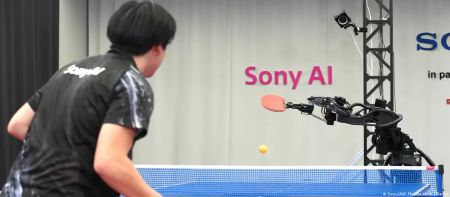
That's precisely where one of Ace's greatest achievements lies. The system not only detects the ball's trajectory but also the spin it carries. Thanks to ultra-fast cameras and advanced sensors, the robot calculates in real time how to react and executes extremely precise shots. It's even capable of returning balls with spin, just like professional players.
AI learns by observing and practicing. The most interesting thing isn't just that the robot plays well. What's truly revolutionary is how it learns. Ace uses reinforcement learning techniques, a branch of AI that allows systems to improve through experience and repetition. The robot observes the human player, analyzes patterns, tests responses, and learns from its mistakes.
After hours of training and thousands of rallies, the system autonomously improves until it can compete at the level of elite players. In fact, Sony AI claims that the robot has already managed to defeat professionals in real matches under official rules.
And this is where the real technological shift occurs. The future of robotics applied to other fields related to the "physical world": industrial plants, hospitals, open fields, etc. This is the arrival of so-called "physical AI."
Until now, many industrial robots worked in isolation inside safety cages. They performed repetitive and highly controlled tasks, but had enormous difficulty adapting to unexpected changes.
Now this is beginning to change. The combination of robotics and artificial intelligence allows for the creation of machines capable of observing their surroundings, interpreting situations, and reacting in real time—exactly as happens during a table tennis match.
This opens the door to much more advanced collaborative robots in factories, hospitals, logistics, transportation, and even domestic assistance.
In the coming years, we will see robots capable of working alongside people with greater safety and autonomy, continuously adapting to their surroundings.
A change that has already begun.
 EN
EN  ES
ES