
Views: 4
We constantly talk about artificial intelligence in our phones, cars, and at work. But there's a much more "humble" vehicle that's also transforming at breakneck speed: the bicycle. It's no longer just about wheels and pedals. More and more models incorporate electric motors, sensors, cameras, and algorithms that assist the cyclist before, during, and after each ride.
Electric bicycles are no longer an expensive luxury. Today, their price is within reach of many budgets, and the advantage is clear: pedal assist that makes hills and long distances much easier.
But the innovation goes beyond the simple motor. Some systems already use artificial intelligence to adjust the assistance in real time according to the resistance the cyclist encounters while pedaling, achieving a smoother and more natural ride, almost as if the bike "reads" the effort of the rider.
The most striking leap forward is being made by companies like Canyon, a German manufacturer that has unveiled a prototype called Predict. It's a bicycle equipped with 360-degree cameras, radar, and motion sensors that analyze the surroundings in real time to warn of hazards before the cyclist even perceives them.
The system processes all the information directly on the bike itself (known as edge AI), without relying on the internet, which reduces response time and protects privacy. In critical situations, it can even automatically lower the saddle height to improve stability before a potential fall.
You can learn more about these developments on the company's website: www.canyon.com
Furthermore, some companies are complementing their bicycles with a smart helmet that projects warnings and navigation data directly into the cyclist's field of vision, eliminating the need to look at a screen.
But here's the paradox. With so much innovation available, one would expect a boom in bicycle use in cities. And yet, growth remains minimal, and its use is very moderate.
The main reason isn't technological, but urban planning-related: there's a lack of safe and well-connected bike lanes. Madrid is a prime example. Despite having already surpassed 1,100 kilometers of cycling infrastructure, much of that network consists of shared lanes with traffic, not truly segregated lanes, and it remains one of the worst-performing cities in this area when compared to the total surface area of its roads.
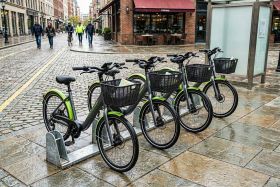
The BiciMAD public bike-sharing system itself, now fully electric, has seen a surge in ridership in recent years thanks precisely to electric assistance, demonstrating that technology does work as an incentive, but much more so if combined with safer conditions.
The key piece is missing: infrastructure. Neither the most advanced AI nor the most futuristic helmet can replace a protected bike lane. As long as sharing the road with traffic remains the norm in many cities, a large part of the population will continue to be hesitant to cycle daily.
The technology is ready. Now our cities need to be ready too. Will we ever see it?
 EN
EN  ES
ES