
Views: 19
Until recently, the robotaxi was almost exclusively the domain of the United States. Waymo, Google's subsidiary, set the pace with paid services already operating in several North American cities. But the landscape is changing rapidly, and China has entered the conversation with a force that surprises even the most astute analysts.
The robotaxi is no longer a laboratory curiosity. It's a real business, with cars driving without drivers and charging fares like any taxi. And in this race, three Chinese names are increasingly prominent: Baidu (Apollo Go), Pony.ai, and WeRide. They are joined by other players such as AutoX and DiDi Autonomous Driving, in a domestic market as competitive as China's, where it's only a matter of time before more emerge.
These companies are no longer limited to China. They are signing agreements with Uber to launch in the Middle East, and in 2026 they took a symbolic leap: the first commercial robotaxi operation in Europe, in Croatia, in partnership with Pony.ai, Uber, and Verne. Baidu, meanwhile, is working to reach London, and WeRide already operates commercially in Abu Dhabi and Dubai.
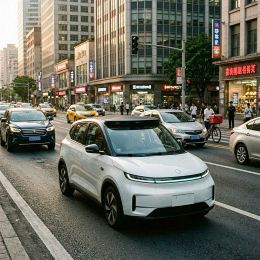
Why can China compete head-to-head? The answer lies in something we already know: the electric car. China dominates its manufacture and achieves prices that the West has yet to match. A robotaxi, in essence, is an electric car with additional (not particularly expensive) sensors and a computer system capable of making real-time driving decisions.
The real difference isn't in the bodywork, but in the software. And that's where Waymo, more of a technology company than a car manufacturer, had the advantage... until now. Chinese companies have accumulated kilometers and data at a breakneck pace: Baidu has completed millions of commercial trips in more than a dozen cities and claims to have achieved profitability per vehicle in Wuhan.
The obstacle isn't technological; it's trust. Herein lies the real impediment to any international expansion: data. A robotaxi needs precise knowledge of a city's traffic and, while driving, generates highly sensitive information about streets, movements, and people. For a foreign company to accumulate this volume of data in another country's major cities is no small matter; it's a national security issue for many governments.
This explains why Chinese companies are proceeding cautiously outside of Asia and the Middle East, and why their arrival in Europe relies on local partners like Verne or Uber, rather than operating independently.
It's important not to confuse the robotaxi with the driver assistance systems already incorporated in many modern cars. These systems still require the driver's attention and responsibility. The robotaxi is something else entirely: a service designed to get around the city without a driver, and its success depends more on software and regulatory confidence than on the vehicle itself.
If we ask ourselves, "Who's winning?" Today, beyond Waymo, it's Chinese companies that have the most autonomous cars on the road and are accumulating the most real-world experience in different markets. This gives them a considerable learning advantage.
But the robotaxi's definitive takeoff as a mass-market business is still some time away. It needs to gain the trust of users, street by street, and overcome the reluctance of governments to open their doors to foreign companies that will literally know every corner of their cities.
The playing field is shifting. And, as with so many other key technologies of this decade, everything points to the game being played between Washington and Beijing, with Europe watching from the sidelines... for now.
 EN
EN  ES
ES