
Views: 10
Just over a month ago, from July 6 to 7, 2026, a historic meeting was held in Geneva: the first UN Global Dialogue on AI Governance. More than 4,000 people from governments, businesses, and civil society sat down to discuss something that affects us all, although very few have had a voice until now: how to control the development of artificial intelligence.
This is not the first time the UN has tried. António Guterres has been warning for years about the risks of AI without rules. This time, however, the meeting was different: for the first time, all 193 member states sat down together specifically to discuss this issue.
In his opening address, Guterres was emphatic. He described the advance of AI as an experiment being conducted on our societies without a plan and without consent. He added a phrase that aptly summarizes the underlying problem: machines can provide information, but it must be people who decide and respond.
The diagnosis is worrying. The development of cutting-edge AI is concentrated in a handful of companies and just a couple of countries, while most of the planet has little say in a technology that will shape its immediate future. It is, at the very least, a highly unbalanced situation.
To try to correct this, Guterres announced that he will present his proposal for a Global AI Fund to the General Assembly, intended to finance training, data, and affordable computing power worldwide. The goal is to prevent an even wider gap from opening between countries that already master the technology and those that are falling behind.
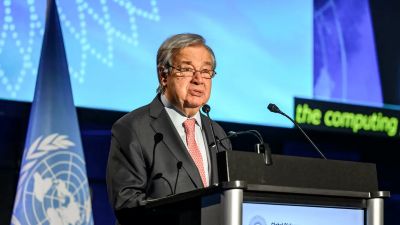
There was also talk, once again, of lethal autonomous weapons systems: the so-called "killer robots," capable of deciding for themselves whether or not to kill a person. Guterres called them morally repugnant and demanded that they be banned under international law. He already requested it in previous years. We'll see if there's real progress this time.
There was a convergence with another global voice. It's significant that, just a couple of months ago, the Pope dedicated an encyclical to reflecting on the ethical risks of artificial intelligence. Two very different institutions, the UN and the Vatican, agree on the same underlying message: coexistence and the shared development of humanity must outweigh economic gain or the short-term power of a few.
I have to admit that, frankly, it's hard to be optimistic. We've had years of warnings, summits, and declarations of intent, and the practical results remain scarce compared to the speed at which technology is advancing. The Geneva Dialogue itself has no binding power: its strength lies in setting norms and coordinating efforts, not in forcing anyone.
Even so, the fact that 193 countries have sat down at the same table is, at the very least, a necessary first step. The next chapter will be written in New York in 2027. I hope I'm wrong in my skepticism, and this time the words become deeds.
Time will tell.
 EN
EN  ES
ES