
Views: 14
There are inventions that change the world silently, without fanfare or headlines. Fiber optics is one of them. Today, 60 years after it all began, it deserves well-deserved recognition.
What exactly is fiber optics? Imagine a strand of glass as thin as a human hair. Light travels through it, and that light carries information. At one end, a laser modulates it with digital data; at the other, a receiver reconstructs it. Thus, with almost poetic elegance, fiber optics works. Simple to explain, very complex to manufacture.
In 1966, Charles K. Kao and George Hockham, from the Standard Telephones and Cables laboratories in England, proposed that it was possible to manufacture glass fibers with much greater transparency, and suggested using them to transmit telephone messages, replacing electricity and metallic conductors. It was a revolutionary idea that many did not believe was viable.
Four years later, the challenge was accepted. And in 1970, scientists at Corning Inc. developed the first low-loss optical fiber, paving the way for the information superhighway. The key was using ultra-pure silica manufactured from vapor deposition, avoiding the impurities that until then had rendered the signal unusable over long distances.
Kao's pioneering work did not go unnoticed by the Swedish Academy. In 2009, 43 years after its historic publication, he was awarded the Nobel Prize in Physics. A belated but absolutely deserved recognition for someone who saw the future before anyone else.
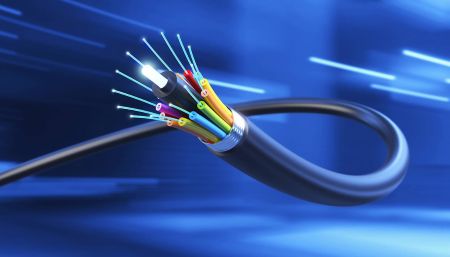
Today, optical fiber is not just a scientific curiosity: it is the backbone of the Internet. Currently, there are more than 2 billion kilometers of optical fiber laid worldwide. It's in the submarine cables that cross the oceans, in the networks that connect continents, and very likely in your own home: that cable that goes through the wall and powers your router is almost certainly fiber optic.
Current speeds are almost unbelievable compared to the first systems: today, transmissions of up to 800 Gbps per channel are achieved, something unthinkable just a few decades ago.
And what awaits us? Research continues at a breakneck pace. Innovations like Hollowcore fiber optics—with a hollow core—promise to further reduce latency and increase speeds.
More efficient and flexible multicore fiber optics are also being developed, using new compounds that increase durability and the efficiency of light transmission. Fiber optics, far from being a mature and stagnant technology, continues to evolve at a rapid pace.
This reflection is a collective expression of gratitude. Sixty years of fiber optics are also sixty years of engineers, physicists, technicians, and companies that have worked to make a brilliant idea a daily reality. Thanks to them, the world is more connected, faster, and closer.
Long live fiber optics.
 EN
EN  ES
ES