
Views: 24
Aviation faces a significant problem: it is highly polluting, and currently, there is no easy solution. Electric cars are already on our roads, and trains are moving towards decarbonization. But airplanes still depend almost entirely on kerosene, and the reason is simple: weight is everything when it comes to flying.
An electric vehicle carries its own batteries and recharges them when they run out of power. But an airplane weighing several tons needs so much energy to stay airborne that current batteries would be too heavy to be viable. The energy density of kerosene is difficult to match. That's why the aeronautical industry is looking in another direction: hydrogen.
Hydrogen has a huge advantage: it weighs very little, and its combustion produces only water vapor. However, it also has its complications: it must be stored at very low cryogenic temperatures or extremely high pressures, which adds technical complexity and weight to storage systems, both on the ground and in the air.
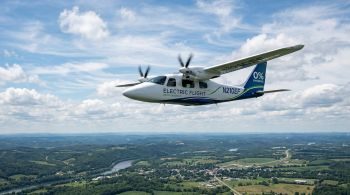
On April 4, 2026, in the city of Zhuzhou, Hunan province, a 7.5-ton unmanned cargo aircraft successfully completed a flight powered by a turboprop engine fueled directly by hydrogen. The aircraft reached an altitude of 300 meters, covered 36 kilometers at 220 km/h, and landed without incident after 16 minutes in the air.
Sixteen minutes may seem like a short time. But in engineering, 16 minutes is enough to demonstrate that something truly works, outside the laboratory and under real-world conditions.
The heart of this feat is the AEP100 turboprop engine, developed by the Hunan Aviation Engine Research Institute, part of the Aircraft Engine Corporation of China (AECC). With over 1 megawatt of power, it is considered the world's first liquid hydrogen engine to reach this power level.
A video can be seen at: https://www.youtube.com/watch?v=DxGhB-k93ws
What changes with this flight is not that hydrogen has arrived in commercial aviation, but that the technology is beginning to enter a more serious scale. A megawatt-class engine no longer belongs to the realm of experimental prototypes, but to that of platforms that could make sense in real-world cargo operations, regional logistics, or low-altitude aviation.
China is not alone in this race. In the West, several companies have been advancing along similar paths for years, albeit with different technical approaches. ZeroAvia is one of the most active companies, focused on hydrogen-electric propulsion systems for aircraft with 9 to 19 seats, with plans to expand the technology to aircraft with 40 to 80 seats. Their approach uses fuel cells that convert hydrogen into electricity to power electric motors, instead of burning it directly. KLM and ZeroAvia plan to conduct a test flight in 2026 with the ZA2000 engine, designed specifically for large regional turboprops.
Meanwhile, Airbus maintains its goal of having zero-emission commercial aircraft in service by 2035, although the first flight tests of its ZEROe program are also expected in 2026 and could be delayed.
The fact that several teams in different parts of the world are testing similar ideas is very good news. Each mistake made by one can be the solution for the next. Competition, far from being an obstacle, accelerates progress.
Hydrogen also faces the ongoing challenge of its cost. Today, producing green hydrogen sustainably is expensive. Electrolyzers are expensive, distribution infrastructure is scarce, and the market is small. But the history of technology teaches us that prices fall when markets grow.
China is developing a broader strategy that encompasses everything from fuel generation to its use in aircraft, seeking to build a complete hydrogen production and utilization chain. If this model prospers, and if demand from the aviation industry takes off, it is reasonable to expect costs to fall rapidly, just as happened with solar panels or lithium batteries.
A paradigm shift seems to be underway. Although hydrogen will not replace conventional fuel in the short term, these pilot projects and investments in supply chains are paving the way for regional aircraft that, in the second half of this decade, could operate with zero emissions.
The recent flight from Zhuzhou is not the arrival; it is a departure signal. There is still a long way to go—infrastructure, certifications, costs, scalability—but for the first time, an aircraft weighing almost eight tons has demonstrated that it can fly without burning a single drop of kerosene. And that, in aviation, is a very significant change.
We'll see how events continue to unfold, and how quickly they do so.
 EN
EN  ES
ES