
Views: 4
For many years, we thought the internet was a powerful tool at our disposal. We believed we were free users, capable of deciding what to watch, what to buy, or who to connect with. However, the current reality is far more complex. Perhaps we are no longer simply users or customers. In a way, we have become mere perpetual generators of data.
Every time we perform a search, click "like," watch a video, share a photo, or linger on a post for a few seconds longer, we leave a digital trail. This trail has enormous economic value. Data is the fuel of the digital economy, allowing companies to understand our tastes, habits, emotions, and even anticipate some of our decisions.
Large digital platforms don't profit solely from offering a service. Their real business lies in collecting, analyzing, and utilizing the vast amount of data we generate. The longer we stay connected, the more information they obtain about us, and the greater the value of that data for personalized advertising, artificial intelligence, and other commercial applications.
That's why algorithms are designed to hold our attention for as long as possible. They're not necessarily trying to keep us better informed, but rather to keep us on the platform. Every recommendation, every suggested video, or every news item that appears on our screen is based on mathematical models trained to capture our interest and prevent us from leaving the app.
The result is a vicious cycle that's very difficult to break. The more we interact, the more data we generate. The more data we generate, the better the algorithms know us. And the better they know us, the more effective the recommendations we receive become at keeping us engaged.
Various studies on digital behavior and the attention economy show that platforms compete for a very limited resource: our time. Attention has become one of the most valuable commodities of the 21st century. It's no coincidence that many people check their mobile phones dozens or even hundreds of times a day, most of the time without a real need. Notifications, sounds, and vibrations act as small stimuli that entice us to return again and again.
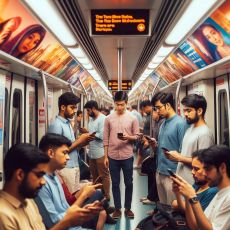
Just look at any subway station, bus, café, or waiting room. Most people have their eyes glued to their mobile phone screens. Even walking down the street, it's common to see people completely absorbed in their devices. Everyone seems entertained, but at the same time, they're all feeding the enormous data system that sustains the digital business.
This dynamic also has social consequences. When so much of the information we receive is selected by algorithms, there's a risk that our opinions will become increasingly similar to those of others who receive similar content. Furthermore, groups with significant technological capabilities can use automated tools, such as botnets or coordinated campaigns, to amplify certain messages and influence public discourse, modifying our opinions and behavior.
All of this makes developing critical thinking increasingly important. It's not about demonizing technology, which offers extraordinary advantages in education, communication, and access to knowledge. It's about understanding how it works so we can use it, and not allow it to end up using our time, our attention, and our actions.
Some people suggest going back to using basic phones, the so-called "dumb phones." This might be an interesting option for certain people, but it's probably not necessary to go that far. There's a much simpler alternative: reducing our use of social media and regaining control over our downtime.
A simple measure like turning on airplane mode for a good part of the day or checking apps only every three or four hours can significantly decrease our dependence on notifications. In most cases, nothing truly urgent requires an immediate response. We're the ones who have ended up accepting a constant availability that is hardly necessary. We need to reclaim time to talk, read, take walks, or simply think without interruptions. It might seem like a small gesture, but it represents recovering an important part of our autonomy. Because the true luxury of the future may not be having more technology, but being able to decide when we want to use it and when we prefer to live apart from it.
Each person will choose their own balance. The important thing is to do it consciously. Because, while we think we're just browsing the internet, perhaps what we're really doing is feeding a machine that learns a little more about us every day, in order to control us better.
Everyone can do what they want and should make their own conscious choice.
 EN
EN  ES
ES