
Views: 39
Batteries are everywhere. In our cell phones, wireless headphones, TV remotes, and smart home sensors. They are the invisible heart of the portable era. And this massive and competitive market is clearly dominated by large Chinese companies.
But in this saturated ecosystem, a different story has just emerged. It's called Flint, a small startup based in Singapore, and it has achieved something very few manage: creating a genuinely new, more sustainable battery that has been in production since January 2026.
The key lies in a material as commonplace as it is unexpected: cellulose, the plant fiber that makes up paper. Flint integrates it into the cathode, the electrolyte, and the separator of its batteries. That's why they are known as paper batteries, although their performance is anything but artisanal.
Its most important features are: Energy density 226 Wh/kg, operating voltage 4.2 V, and 1,000 charge cycles.
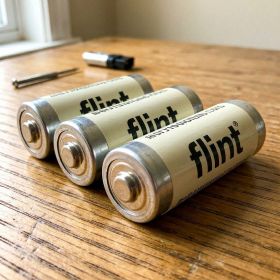
These figures are very competitive for the everyday consumer device segment. They don't reach the peak performance of the latest lithium-ion batteries, but they don't need to in order to power wireless mice, keyboards, IoT sensors, or e-readers.
One of the most striking advantages is safety. Contrary to what one might assume upon hearing "paper battery," these cells are flame-resistant and won't explode if damaged. Flint's proprietary cellulose and electrolytes allow them to withstand even extreme situations. Furthermore, their flexibility allows them to be manufactured in multiple formats: from the standard AAA size to sheets adaptable to any surface.
And there's another equally important fact from an environmental perspective: their manufacture doesn't use cobalt, lithium, nickel, or toxic solvents. The process is water-based, with a significantly lower carbon footprint than conventional batteries.
Beyond the technology itself, this story has something worth highlighting: ingenuity knows no bounds. A small company, with a clear idea and a lot of hard work behind it, has managed to enter one of the world's most challenging markets. When creativity and sustainability align, they can find their niche even against giants.
Flint has announced supply agreements with Logitech, and Amazon is exploring its use in future Kindle models, taking advantage of the cells' fine flexibility. All the best to the Flint team. They need it, and they deserve it.
You can see the company's website at: https://www.flintlabs.com/
 EN
EN  ES
ES