
Views: 8
Maritime transport moves more than 80% of world trade, but it is also one of the most difficult sectors to decarbonize. Ships need enormous amounts of energy to travel long distances, and replacing traditional fuel is neither simple nor cheap. The same is true for aviation: both sectors have been searching for clean and viable alternatives for years.
One of the most promising options is hydrogen. The historical problem has been its storage: to transport it in usable quantities, it needs to be compressed to very high pressures or cooled to extremely low temperatures. This presents a serious logistical challenge. But once the hydrogen reaches the engine, the energy it releases is clean and efficient.
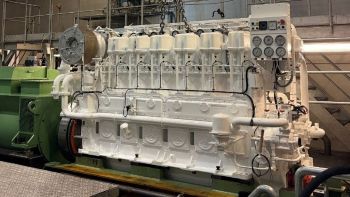
The Belgian company BeHydro has just achieved a significant milestone: Lloyd's Register, one of the world's most prestigious maritime classification societies, has certified its marine engine that runs exclusively on hydrogen, meeting the demanding international standards for safety, reliability, and performance.
This engine is not a laboratory prototype. With a power output of up to 2,670 kW, it is designed to operate both as the main propulsion system and to power electrical generators on board vessels of varying sizes. Furthermore, the range of 100% hydrogen engines is available from 900 kW to 2,670 kW, adapting to different marine applications.
An interesting technical feature: unlike hybrid systems, the BeHydro engine does not require diesel or other fossil fuels to ignite the mixture, which simplifies vessel design and reduces auxiliary systems.
For shipping companies, obtaining Lloyd's Register approval is not a mere formality. In a sector where safety is the absolute priority and ships operate for decades, independent certification is essential for any new technology to aspire to real commercial adoption.
This is not BeHydro's first step on this path: Lloyd's Register had already granted the company's first type approval for a dual-fuel hydrogen engine in 2023, so this new certificate confirms a solid track record.
But this is not the end of the story. Hydrogen storage and transport remain major challenges. And there is another important nuance: a hydrogen engine will only be as clean as the source of the fuel it consumes, and currently much of the world's hydrogen is still produced from natural gas, with significant CO₂ emissions. For the environmental impact to be truly positive, the production of green hydrogen through electrolysis using renewable energy needs to be scaled up.
The complementary good news is that Europe, Japan, South Korea, and several Gulf countries are already driving large-scale projects to develop renewable hydrogen supply chains capable of supplying ports and heavy industry.
Climate change is relentless, and every step forward like this—though there's still work to be done—is a sign that the maritime sector is beginning to take its energy transition seriously. It remains to be seen when we'll see tangible results of ships sailing without polluting.
 EN
EN  ES
ES