
Views: 11
Every year, fires ravage thousands of hectares and claim human lives and property across the globe. We see the major fires in the news, but there are countless smaller ones that never make the headlines. Extinguishing them as quickly as possible is key to preventing them from becoming catastrophes. And that's where a simple yet promising idea comes in: fighting fire with extreme cold.
The story of this idea begins in 2008, in a laboratory at Northeastern University (USA). Professor Yiannis Levendis was experimenting by burning shredded tire debris as a possible alternative fuel to coal. On impulse, he grabbed a spoonful of liquid nitrogen and threw it onto the flames. The result was astonishing: the fire was extinguished almost instantly.
Nearly twenty years later, that idea has become a real prototype: a robot capable of extinguishing forest fires with liquid nitrogen without leaving any chemical trace in the environment.
How it works: Liquid nitrogen works in two ways at once. When sprayed on the fire at -196°C, it evaporates and expands almost 1,000 times its volume, displacing the surrounding oxygen and smothering the flames. At the same time, its extreme temperature rapidly cools the burning material, eliminating the heat the fire needs to continue spreading.
And it has an added advantage: unlike many current fire retardants, which contain phosphorus and can contaminate soil and waterways, liquid nitrogen leaves no chemical residue whatsoever, as it simply re-enters the atmosphere as a gas.
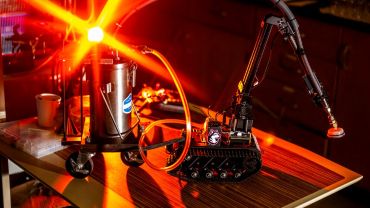
By putting robots on the front lines, people are kept safe. To apply nitrogen, the team has designed a tracked robot, equipped with tanks and hoses resistant to extreme cold, capable of approaching fires in areas difficult or dangerous for firefighters to access. The logic is as simple as it is compelling: it's preferable to lose a machine than to risk a life.
Currently, the prototype is being evaluated in controlled burns with typical forest vegetation, and its initial objective is not to extinguish large, already raging fires, but to act quickly on small outbreaks before they become uncontrollable.
The project, funded by the Gordon and Betty Moore Foundation, is still in the testing phase. But if the results continue to be positive, this technology could be rapidly scaled up and become another ally in the global fight against forest fires, protecting forests, people, and the planet itself.
Hopefully, it will soon become a reality, and we will see it as soon as possible.
 EN
EN  ES
ES