
Views: 18
Can you imagine watching a live, high-definition broadcast from the Moon? What seemed like science fiction a few years ago is now a reality. Space communications are abandoning old radio waves to reach the speed of light thanks to lasers. And yes, this changes absolutely everything.
From radio to 4K video from the Moon. The major turning point has arrived thanks to NASA and the Artemis II mission. During its journey around the Moon, the crewed spacecraft served as the perfect laboratory for a historic test: transmitting ultra-high-definition (4K) video via laser from deep space to a ground station in Australia.
Until now, space missions relied on radio waves. The problem is that radio is slow by today's standards. Lasers, by using much higher frequencies, allow for massive bandwidth. This means we can send thousands of times more data per second. The best part is that this technology is not only infinitely faster, but its cost is also much lower than that of traditional antennas.
This technology isn't just for communicating with astronauts. We're already using it on Earth without even realizing it. The famous Starlink satellite constellation uses laser links to interconnect with each other in the vacuum of space.
In fact, many experts suggest that a global network of satellites interconnected by high-speed lasers could become the perfect backup system for submarine fiber optic cables. If a cable breaks on the ocean floor, the world's internet could leap through space at the speed of light.
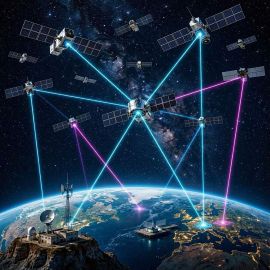
But it's not all advantages; the biggest enemy of lasers is clouds. While radio waves pass through clouds and storms with ease, clouds are the Achilles' heel of lasers, as they absorb and attenuate the optical signal.
One solution could be a smart network of ground stations. If the sky over Madrid is cloudy, the satellite simply redirects the laser beam to a station in southern Spain or Portugal where the sun is shining. By hopping information from one satellite to another, the network automatically avoids bad weather.
The other major challenge is traffic, because space is starting to become somewhat saturated. There are currently around 9,000 active satellites orbiting our planet, and the number is constantly growing. This saturation demands pinpoint accuracy to prevent the light beams from crossing or causing interference.
Fortunately, the industry is responding quickly. Dozens of technology companies are developing low-cost, ultrasensitive photodetectors and state-of-the-art automated alignment systems. This allows satellites the size of a shoebox (so-called CubeSats) to point and connect with each other thousands of kilometers away with surgical precision.
We are in the era of global communications, and this is just the beginning. Interplanetary internet is already here, and it travels on the back of a beam of light.
 EN
EN  ES
ES