
Views: 12
Every week, images of drones in action emerge: in Ukraine, in Iran, in dozens of conflicts around the world. Almost always, the focus is on the moment of impact, the explosion, the destroyed target. But behind every attack lie hours, sometimes days, of much less visible work: intelligence gathering.
The silent face of drones: surveillance and intelligence. Before a combat drone is deployed, someone has to know where to look. This function is fulfilled by other, much more discreet drones, designed not to destroy but to observe. They fly over enemy lines, identify movements, locate positions, and send all this information to a control center in real time.
This is the aspect of conflict that almost never appears in headlines, even though it underpins everything else. They are small, but crucial, because you don't need giants for surveillance. In fact, it's usually the other way around. Many of these devices weigh less than 500 grams and can stay airborne for up to an hour, collecting data without endangering anyone.
The smaller a drone is, the harder it is to detect. Some models weigh just a few grams, although this comes at the cost of reduced range. It's a constant balancing act between discretion and capability, and artificial intelligence is pushing that limit further and further, allowing these devices to fly autonomously and recognize targets on their own.
Ukraine is the country that changed the game. Few imagined a few years ago that Ukraine would become a global leader in drone development. Thanks to massive domestic production and constant adaptation on the battlefield, the country has managed to hold its own against an adversary with far greater resources. Today, it is one of the world's leading manufacturers and innovators of drone technology.
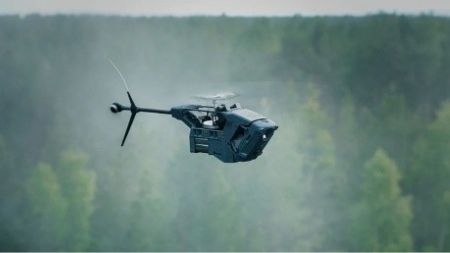
A good example of how far this technological race has gone in this field is Black Recon, the new microdrone presented by Teledyne FLIR Defense. It weighs less than 450 grams, can fly for up to 60 minutes, and reaches speeds of around 90 km/h.
It operates almost autonomously, functioning day and night thanks to its thermal imaging capabilities, and can do without GPS to avoid being intercepted or deceived. The complete system includes up to three units: while one is in the air exploring, another can be recharging at its base, ready for the next flight.
A video can be seen at: https://www.youtube.com/watch?v=iL4fxqAk_08
Many other similar systems exist, less well-known to the general public but perfectly understood by those working in the defense sector. The race for miniaturization and autonomy continues to accelerate.
As has happened so often, military technology ends up finding civilian applications. GPS is the most well-known example, and everything indicates that current advances in autonomous drones will follow the same path, reaching agriculture, logistics, and emergency management.
Technology, in the end, develops first where it's most needed. And while there's nothing more valuable than saving human lives, wars are dedicated to precisely the opposite. One of the great paradoxes of our time.
As an engineer, I find this technological evolution fascinating. As a person, I can't help but think that armed conflicts continue to demonstrate the same old thing: that ego and self-interest continue to take precedence over the collective good. Thousands of years of history, and deep down, we still haven't learned the lesson.
What a shame!
 EN
EN  ES
ES