
Views: 25
If there's one company that never ceases to amaze in the world of electric power, it's CATL. The world's largest battery manufacturer has just unveiled its new technologies at its Tech Day 2026, held just before the Beijing Auto Show. The setting was perfect: thousands of manufacturers gathered in the Chinese capital, ready to see what's coming. And there's a lot.
The star of the event was the third generation of the Qilin battery. This new version achieves an energy density of 280 Wh/kg and, with a 125 kWh pack, allows for a real-world range exceeding 1,000 km.
But the most striking aspect isn't just the range. The complete pack weighs 255 kg less than an equivalent LFP battery, which translates to half a second less acceleration from 0 to 100 km/h and a meter and a half less braking distance. An improvement that completely changes the car's dynamic behavior.
And if that weren't enough, CATL has also unveiled a condensed version of the Qilin battery that raises the density to 350 Wh/kg, which could allow for ranges of up to 1,500 km in high-end sedans. Madrid to Paris without recharging, with plenty of range to spare.
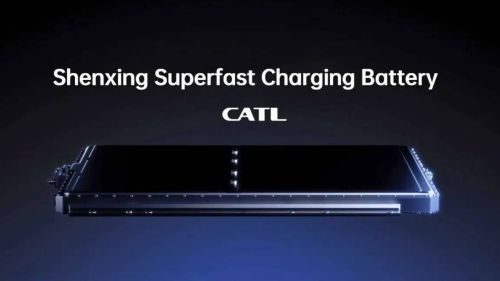
The other major barrier for electric cars has always been charging time. CATL has also tackled this issue. Its new third-generation Shenxing battery can charge from 10% to 98% in less than 7 minutes, and from 10% to 80% in just under 4 minutes.
And most importantly: even at -30°C, the battery can go from 20% to 98% in approximately 9 minutes, and after 1,000 full charge cycles, it retains more than 90% of its capacity. Extreme cold, long life, lightning-fast charging. Excuses are running out.
Beyond lithium, CATL has another ace up its sleeve. The company has promised to begin mass production of sodium-ion batteries before the end of the year, a technology that reduces dependence on lithium, cobalt, and nickel.
This is key: cheaper batteries, with more abundant materials and less reliance on complicated supply chains. A strategic move that could democratize electric cars.
CATL isn't innovating in a vacuum. It has a rival hot on its heels. Together, CATL and BYD control more than half of the global electric vehicle battery market, with CATL closing 2025 with 39.2% of the global market and BYD in second place with 16.4%.
This fierce competition between Chinese giants is, paradoxically, great news for consumers. Every time one advances, the other responds. And the pace of improvement accelerates.
The two main arguments against electric cars—range and charging time—are falling apart one after the other. With batteries that offer over 1,000 km of range and charging times of less than seven minutes, the debate is no longer technical. It's about infrastructure, price, and the will to change.
Traditional manufacturers who continue to rely on fossil fuels have their days numbered. The market hasn't fully embraced it yet, but technology has already made its decision.
And if not, time will tell.
 EN
EN  ES
ES