
Views: 8
Artificial Intelligence (AI) and robotics are transforming the world at an unprecedented pace. What seemed like science fiction just a few years ago is now part of the daily reality for thousands of companies. Robots capable of working autonomously, AI systems that write reports, serve customers, program software, or analyze vast amounts of data are changing the way goods and services are produced.
This technological advancement offers enormous benefits. Companies can increase their productivity, reduce costs, and develop new products more quickly. However, alongside these advantages, an increasingly frequent question arises: what happens to workers whose tasks can be replaced by machines or AI agents?
Various experts, economists, and social thinkers have begun to raise an idea that seemed unthinkable a few years ago: if robots and AI generate wealth, should they contribute in some way to collective well-being?
It's not about robots receiving a paycheck or having a bank account. The proposal is more about companies that replace human labor with automated systems providing social compensation. Some call it a "robot tax," while others prefer to speak of a technology contribution or a job adaptation fund.
The idea isn't to punish innovation. In fact, history shows that technological progress often generates new economic opportunities. The problem arises when the benefits of that progress are concentrated in very few hands while a portion of the population is displaced from the labor market.
This debate is already taking place in various parts of the world. In countries like England and South Korea, discussions have emerged about how to manage the social impact of automation. Even figures as well-known as Bill Gates have suggested in the past exploring ways for robots to contribute to the tax system when they replace certain human functions.
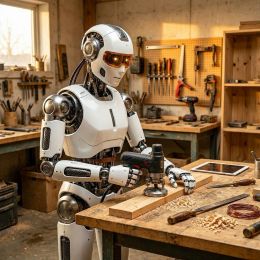
The fundamental question is simple: if a company significantly increases its profits through automation, should there be a mechanism to redistribute a small portion of that new wealth to fund training, retraining, or support for those who need to adapt to the new job market?
It's important to clarify that we're not talking about giving away money or encouraging inactivity. The goal would be to facilitate the transition to a more advanced economy, ensuring that no one is excluded from technological development. Just as public education and infrastructure benefit society as a whole, some believe that the AI revolution should also generate shared social returns.
Furthermore, the speed of current change is particularly relevant. While previous industrial revolutions took decades to unfold, Artificial Intelligence is evolving in a matter of months. Each new generation of systems is capable of performing more complex tasks, reducing the need for human intervention in numerous repetitive and even creative processes.
No one knows exactly how many jobs will disappear or how many new ones will emerge. What does seem clear is that the labor market of the future will be very different from the current one. Therefore, it is reasonable to open a serious debate about how to distribute the benefits of an increasingly automated economy.
Perhaps the ultimate solution is not a tax on robots or a specific levy on AI. Perhaps more sophisticated and balanced mechanisms will emerge. But ignoring the problem would be a mistake. A truly advanced society should not measure its success solely by corporate profits, but also by its ability to ensure that progress reaches the greatest number of people possible.
Because if we allow greed to be the sole driving force of technological development, we risk building a more efficient, but also more unequal, future. And that would likely be the greatest failure of our digital age.
 EN
EN  ES
ES