
Views: 52
There was a time, not so long ago, when the "Made in Japan" label on a television was the gold standard of global technology. Names like Sony, Panasonic, and Toshiba dominated our living rooms with a blend of prestige and cutting-edge technology. However, the consumer electronics landscape has taken a 180-degree turn. Today, the news is shocking: there are no longer any Japanese companies manufacturing their own televisions on Japanese soil.
The latest major move was made by Panasonic. The legendary Japanese firm has ceased its own television production to sign a strategic agreement with the Chinese giant Skyworth Global. From now on, the technology that once originated in Japanese factories will be assembled in Chinese facilities.
This path is not new. Sony, the other major player in the sector, has been outsourcing its manufacturing to TCL Technology for some time, maintaining only the design and development of high-end software in Japan. It's a sign of the times: hardware has become a cost battle, while added value resides in design.
The business has shifted towards South Korea (with Samsung and LG leading the OLED and QLED markets) and, massively, towards China. Companies like Hisense and the aforementioned TCL have achieved something that seemed impossible decades ago: offering giant screens with astonishing image quality at prices Japan can't match.
Competition is fierce, and profit margins per unit are increasingly narrow. To survive, traditional brands have had to choose between disappearing or outsourcing.
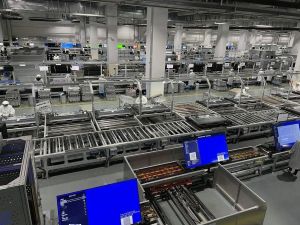
And what's happening in the West? If we look at Europe or the United States, the outlook isn't much more encouraging for local production. In the US, Vizio (in California) is holding on in certain mid-to-high-price segments. In Europe, historic names like Philips (Netherlands) and the almost symbolic Grundig (Germany) maintain limited production, but far from the volumes needed to dictate the rules of the global market.
The most curious thing is the metamorphosis of the brands that once reigned supreme. Companies like Hitachi, Mitsubishi, JVC, Sharp, and Toshiba have evolved. Some have focused on industrial components, others on air conditioning, or even on financial services and infrastructure solutions. The television is no longer the core of their business, but rather a reminder of their glorious past.
This trend doesn't seem likely to reverse. Today's consumer demands the latest technology—4K, HDR, 75-inch panels—at the lowest possible price. And currently, that equation can only be solved with the economies of scale offered by China.
It's the end of a romantic era for Japanese electronics, but the beginning of a stage where artificial intelligence and software matter more than where the motherboard was soldered.
For informational purposes only, I've attached the Global Sales Ranking (Market Share 2025-2026) for televisions.
Position Brand Origin Market Share
1st Samsung South Korea 17% - 19%
2nd TCL China 15% - 16%
3rd Hisense China 11% - 12%
4th LG South Korea 9% - 10%
5th Xiaomi China ~8%
Samsung remains the global leader for the 20th consecutive year (2006-2026), although its market share has slowed due to the growing strength of TCL and Hisense. It's possible that it won't be long before it's overtaken.
That's how business evolves.
 EN
EN  ES
ES