
Views: 22
For decades, science fiction films and novels imagined battlefields populated by autonomous machines. Today, that image no longer belongs solely to fiction. Although they don't frequently appear in headlines, combat robots are already a real part of modern conflicts.
Today's warfare is changing rapidly thanks to advances in robotics, artificial intelligence, and remote control systems. In addition to the well-known aerial drones, unmanned ground vehicles, known as UGVs (Uncrewed Ground Vehicles), are increasingly appearing on the ground. These robots move across the battlefield without a soldier inside, thus reducing the risk to human troops.
Many of these robots are operated remotely. An operator, positioned at a safe distance, observes the surroundings through cameras and sensors installed on the robot. From there, they can drive the vehicle, explore dangerous areas, and even operate and fire weapons.
In most cases, the decision to fire remains human. The robot's sensors detect movement or potential targets, but it is the operator who confirms the action to avoid errors or friendly fire.
Some models incorporate basic autonomous functions. For example, if the connection with the operator is lost, the robot can automatically return to its starting point, avoiding capture or destruction.
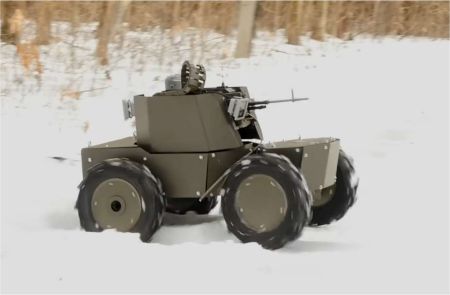
One of the places where this technological evolution is accelerating most rapidly is the conflict between Ukraine and Russia. In this scenario, ground robots are beginning to perform multiple functions on the battlefield.
They are used to:
. transport ammunition or supplies
. evacuate the wounded
. place explosives
. conduct reconnaissance tasks
. operate weapon systems
. etc.
Some models can carry machine guns or other offensive systems, making them potentially lethal platforms. However, their greatest value usually lies in reducing the risk to human soldiers, especially in dangerous missions such as demining or reconnaissance of exposed areas.
According to various defense expert estimates, Ukraine could be manufacturing tens of thousands of UGVs (Unmanned Ground Vehicles) per year. Some even suggest figures approaching 40,000 ground robots by 2026, of which approximately 20% could be armed.
One of the most interesting aspects of this development is that many of these robots are neither extremely sophisticated nor expensive. In many cases, they are relatively simple platforms that combine cameras, wheels or tracks, sensors, and communication systems.
This approach has significant advantages. In a war zone, equipment can be easily lost or destroyed. Therefore, it is sometimes more effective to manufacture many simple, inexpensive robots than a few extremely expensive systems.
In fact, the war in Ukraine has demonstrated something crucial: technological creativity can overcome significant military disadvantages. Against an enemy with greater resources, the combination of drones, robots, and ingenious solutions has allowed for the development of unexpected tactics.
The trend seems clear. We will increasingly see robots in military tasks: transport, surveillance, mine clearance, logistical support, combat, etc.
Military robotics primarily seeks two main objectives:
. reducing friendly casualties
. increasing effectiveness on the battlefield
However, this advancement also opens up important debates. The development of increasingly autonomous systems raises ethical questions about the extent to which machines should participate in life-or-death decisions.
Technology advances very rapidly, often driven by the urgency of conflicts. The paradox is that many innovations born in times of war end up having civilian applications.
Hopefully, one day robotics will be used more for rescuing people, performing risky jobs, exploring other planets, or improving our cities, and less for perfecting the way we wage war.
 EN
EN  ES
ES