
Views: 25
For over a century, automotive steering systems have remained essentially the same: a direct mechanical connection between the steering wheel and the wheels. A robust, reliable system… and until now, unquestionable. However, Mercedes-Benz has decided to take a step that could mark a turning point in the industry: introducing electronic steering, or steer-by-wire, in its Mercedes-Benz EQS model.
What exactly is “steer-by-wire”? The concept is simple, yet its impact is enormous. Instead of a physical steering column connecting the steering wheel to the wheels, the driver's movements are translated into electronic signals. These signals are interpreted by a computer system that decides how to turn the wheels.
There is no direct mechanical connection. Everything is handled by electrical wires and software. While it may seem revolutionary, this system has been used in aeronautics for decades. Modern airplanes employ similar technology because it allows for weight reduction, improved precision, and optimized control. Now, this "old acquaintance" is beginning to make its way into the automotive world.
The logical question is: why has it taken so long to reach cars? The answer lies in the evolution of the vehicle itself. Today, modern cars are veritable computers on wheels. They electronically control everything from the suspension and braking to engine management and driver assistance systems.
In this context, the steering system was one of the last remaining "analog" components. Integrating it into the car's digital ecosystem was only a matter of time.
Furthermore, Mercedes claims to have tested this system for over a million kilometers, providing a crucial level of confidence for such a critical technology.
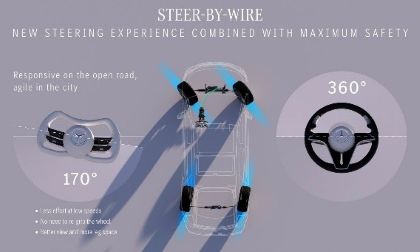
The move to steer-by-wire is not just a technological matter; it also opens up new possibilities:
. Weight reduction: eliminating mechanical components simplifies the design.
. Greater design freedom: Engineers are no longer limited by a physical steering column.
. Software customization: The steering wheel's behavior can be adapted to the driver's preferences or even sold as an optional upgrade.
. Better integration with autonomous systems: Key to the future of driving.
This last point is especially relevant. As we move toward more autonomous cars, having a fully electronic steering system facilitates the transition.
It's not all advantages, though. For many drivers, the idea of replacing a steel rod with a computer system can generate some distrust. Steering is not just any element: it's critical for safety. That's why these systems usually incorporate electronic redundancies and very strict safety protocols.
Even so, the psychological factor plays an important role. The feeling of "physical" control has been part of the driving experience for generations.
Is this the beginning of a new trend? When a brand like Mercedes takes a step of this magnitude, it's rarely by chance. Large companies have the capacity—and the responsibility—to lead the way.
It is very likely that other manufacturers will follow this trend in the coming years, especially in electric and high-end vehicles. What seems like an innovation today could become standard for all cars tomorrow.
We are facing a profound change, comparable to the transition from carburetors to electronic fuel injection or from manual to automatic transmissions. It may initially raise doubts, but if the technology proves to be safe, efficient, and comfortable, it will eventually prevail.
As so often in automotive history, time will be the ultimate judge.
 EN
EN  ES
ES