
Views: 15
When we talk about an electric car, we usually think of the battery as the most important element. However, there is another component that is absolutely key to achieving an efficient vehicle: the electric drive system.
Although its name may sound very technical, its mission is simple to understand: to convert the energy stored in the battery into motion to move the vehicle. But behind this seemingly simple function lies one of the most sophisticated electromechanical systems in the entire car.
The electric drive system integrates the motor, the electronic inverter, and, depending on the manufacturer's design, also the transmission. Its job is to control how much energy is drawn from the battery, transform the direct current into three-phase alternating current to power the motor, generate the torque necessary to accelerate or maintain speed, and recover energy during braking through regenerative braking. In some models, it even manages torque distribution and other transmission elements.
In short, it's the true heart of an electric car's propulsion system. And Geely recently unveiled a revolutionary electric drive. The big news is that the new 16-in-1 integrated electric drive promises to be a game-changer in the efficiency of electric vehicles.
The new system weighs just 75 kilograms, approximately 15% less than current equivalent solutions, and integrates 16 functions into a single compact unit. Thanks to this high level of integration, it also reduces the number of components, wiring, and energy losses, achieving a claimed efficiency of 93.8%.
Integration not only saves weight. It also simplifies manufacturing, improves reliability, and frees up space inside the vehicle—increasingly important aspects in the design of modern electric cars.
And the system offers surprisingly low energy consumption. In tests conducted with the new Geely TT electric sedan, equipped with an 800-volt electrical architecture, the vehicle recorded a consumption of just 8.2 kWh per 100 kilometers on a test route around Qinghai Lake—an exceptionally low figure for a car of its size.
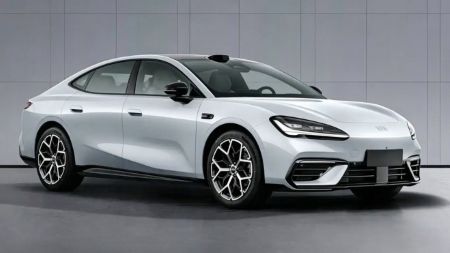
For reference only, most electric passenger cars in a similar category typically consume between 16 and 18 kWh/100 km under normal driving conditions.
Although this result comes from a specific test and should not be interpreted as real-world consumption in any driving situation, it demonstrates the extent to which efficiency can be improved when the entire propulsion system is optimized.
Reducing the energy consumption of an electric car has very important consequences. On the one hand, it allows for the use of smaller batteries to cover the same distance, reducing weight, costs, and the consumption of raw materials.
On the other hand, using the same battery, a considerably greater range can be achieved, one of the aspects most valued by users. Furthermore, a more efficient vehicle needs less electricity to travel each kilometer, which reduces operating costs and also improves its environmental impact throughout its lifespan.
Efficiency is going to be the next major revolution in electric cars. Battery development in recent years has been spectacular. They have increased their energy density, allow for much faster charging, and offer an ever-increasing lifespan.
However, the industry seems to have understood that the next big battle isn't just about manufacturing better batteries, but about making better use of every available kWh.
That's precisely where advances like this new electric drive from Geely can make a huge difference. Efficiency doesn't depend solely on the battery, but also on the entire system that transforms that energy into movement.
For the moment, Geely hasn't announced when mass production of this innovative system will begin. However, if the figures obtained are confirmed under real-world conditions, it's reasonable to think that other manufacturers will accelerate the development of similar solutions.
That's how technological competition works: one innovation drives others. And, in this case, the biggest beneficiaries will be all users, who will enjoy more efficient electric cars with greater range, lower consumption, and increasingly lower running costs.
Without a doubt, this is another milestone that confirms the electric vehicle revolution continues to advance, not only thanks to better batteries, but also through increasingly intelligent and efficient engineering.
 EN
EN  ES
ES