
Views: 12
A few weeks ago, I heard news that seemed to me to be one of the most important of the year: a group of more than 100 former NASA astronauts have decided to join forces to defend something that goes far beyond space: the democracy of their country.
The movement is called Astronauts for America (AFA) and was launched on April 21, 2026, spearheaded by figures such as Garrett Reisman and Steve Lindsey, who serve as co-directors of the organization. They have been joined by such well-known names as Charlie Bolden, former NASA administrator, and astronaut Cady Coleman.
The first thing that stands out is that these astronauts insist, time and again, that their initiative is nonpartisan. Among its members are Republicans, Democrats, and Independents—people from all corners of the country who share something in common: the oath they took upon becoming astronauts to defend the Constitution of the United States.
That commitment, they explain, doesn't end when they hang up their spacesuits. That's why they speak of a new mission, perhaps the most important of their careers: "Today, our country is the mission."
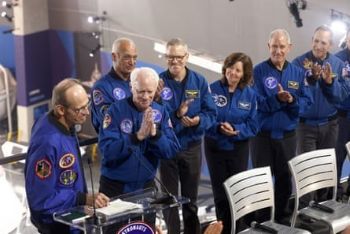
The group points out that, over the last few decades, political polarization has gradually weakened the institutional balances of their country: respect between branches of government, trust in science, the peaceful transfer of power, and the rule of law itself.
And they explain this with a comparison typical of those who have flown to space: when data and evidence are ignored on a mission, the mission's success, and even the lives of the crew, are put at risk. In a democracy, ignoring evidence has a similar cost: trust, stability, and international prestige are lost.
Among its specific objectives, Astronauts for America proposes:
. Promote evidence-based decision-making and the scientific method.
. Evaluate elected officials based on their respect for constitutional principles, not their party affiliation.
. Encourage citizen participation, that is, voting, especially among younger generations.
. Bring together leaders from different sectors to rebuild trust in institutions.
Those who have seen Earth from the window of a spacecraft often repeat the same idea: from up there, you see no borders or flags, only a shared planet. It is this perspective they now bring back to Earth, transformed into a call for unity.
But there is something that is hard to ignore: when more than one hundred people who have risked their lives for their country decide to speak with one voice, it is worth listening to what they have to say. As they themselves remind us, in a democracy—just as in space—what unites us always outweighs what divides us.
We don't know if this initiative will achieve the impact its proponents hope for. Political polarization is a complex phenomenon, with very powerful interests behind it, and it won't be easy to reverse with a single gesture, however symbolic.
The courage of the step they've taken is commendable, and I wish them the best.
 EN
EN  ES
ES