
Views: 0
In recent years, Mexico has become one of the fastest-growing markets for electric cars. However, this growth has a clear protagonist: Chinese manufacturers. By 2025, around 95% of electric vehicles sold in the country were from Chinese brands, demonstrating their enormous dominance in this sector.
But the Mexican government has a different vision. Instead of relying exclusively on foreign manufacturers, it wants to foster a genuine national electric vehicle industry. And this ambitious goal has a name: Olinia.
It is the first electric car designed specifically to meet the mobility needs of Mexicans. Its philosophy is very different from that of the modern electric SUVs we see every day. Here, the priority is not to offer high performance, but to create a simple, economical, practical, and accessible vehicle for millions of people.
Production of the Olinia Uno will begin in the summer of 2027 in Puebla, one of the major centers of the Mexican automotive industry. The project involves Mexican universities, research centers, and engineers, and has the backing of the Federal Government, which considers it a strategic step toward greater technological independence.
To achieve a truly competitive price, its specifications are deliberately modest. It uses a 14.7 kWh LFP (lithium iron phosphate) battery, a technology highly valued for its safety, long lifespan, and low cost. The electric motor develops 13.5 kW, enough to reach a top speed of 50 km/h, more than adequate for urban driving.
Its range is around 125 kilometers, a figure that may seem low compared to other electric cars, but is perfectly sufficient for daily city use. Furthermore, one of its major advantages is that it can be recharged using a standard household outlet, without the need for special chargers.
Another interesting aspect is its design. The Olinia can carry up to six passengers and will also have a cargo version, designed for small businesses, delivery drivers, and urban services. Its target price is 150,000 Mexican pesos, about $8,500 USD, making it one of the most affordable electric cars on the market.
Below you can see a photograph of the vehicle.
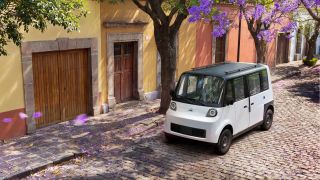
Beyond the car itself, the real interest of the project lies in what it represents for Mexico. For decades, the country has been one of the world's leading manufacturers of vehicles produced by foreign companies. Now it aims to take a much more significant step: designing, developing, and manufacturing its own technology.
Clearly, the road will not be easy. Creating a new automotive brand requires substantial investment, developing a network of suppliers, establishing distribution channels, and gaining market trust. However, all major manufacturers once started from scratch.
Personally, I have to admit that I love the idea. In a way, Mexico is trying to follow a similar path to the one Chinese manufacturers embarked on a little over a decade ago. Today, China leads the global electric car market, but that leadership began precisely by focusing on simple, affordable vehicles adapted to the real needs of millions of users.
There is a huge international market for these types of low-cost urban vehicles. If Olinia manages to offer a reliable, affordable, and easy-to-maintain product, it wouldn't be surprising if, in a few years, we find this small electric car far beyond Mexico's borders.
From here, we can only wish our Mexican friends the best of luck. Hopefully, this project will mark the beginning of a new era in the country's technology and automotive industries.
You can see the company's website at: https://www.olinia.auto/
My Best regards and have a good day
 EN
EN  ES
ES