
Views: 21
The Pentagon has just signed agreements with eight major tech companies to deploy AI on classified networks. No one is saying it out loud, but every country is doing the same thing.
Just a few weeks ago, the U.S. Department of Defense—now officially called the Department of War—announced agreements with eight of the world's largest tech companies: OpenAI, Google, Microsoft, Amazon Web Services, SpaceX, NVIDIA, Oracle, and Reflection.
The goal: to deploy their most advanced artificial intelligence models directly on the military's classified networks. The official statement refers to "lawful operational use." A phrase that, translated into everyday language, basically means: for whatever is needed.
The Pentagon has requested $14.2 billion for AI and autonomous systems in fiscal year 2026 alone. Among its priorities is the "Replicator" program: thousands of autonomous drones and unmanned ships ready for the battlefield.
In this landscape, one name stands out by its absence: Anthropic, the company that created Claude. It was the only one that refused to release its technology without clear guarantees regarding its use. Its argument was straightforward: the latest generation of AI models are not reliable enough to pilot autonomous weapons, and the legal mechanisms to ensure compliance with international law do not yet exist.
The Trump administration's response was to declare Anthropic a "supply chain risk," a label that until then had only been used with companies linked to foreign adversaries. Anthropic sued the government, and a federal judge blocked that measure last month. The story will play out in court, but I doubt it will amount to much.
China is not lagging behind, even if it doesn't proclaim it. Because while Washington makes its announcements, Beijing acts in silence. In January 2026, a demonstration by the People's Liberation Army showed a single soldier controlling a formation of 200 autonomous drones. At the Victory Day parade in September 2025, the headlines weren't about tanks, but about autonomous vehicles, underwater drones, and unmanned combat aircraft.
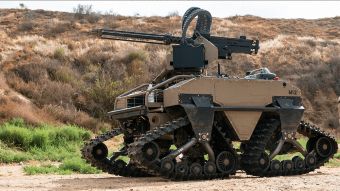
Researchers from universities affiliated with the Chinese military published papers in March 2025 describing swarms of drones capable of executing the entire attack chain in urban environments completely autonomously. Without human approval. Without proportionality assessment. Just algorithms deciding for themselves.
What is happening is neither a conspiracy nor a historical novelty. It's the same old logic: when a transformative technology emerges, states incorporate it into their arsenal as quickly as possible. It happened with airplanes, with radar, with guided missiles. Now it's happening with AI.
The difference lies in speed and scale. And in the fact that, for the first time, machines could make lethal decisions without human intervention in fractions of a second
This isn't a criticism of any particular government. It's the acknowledgment of an uncomfortable reality: national interests are winning out over human interests. And technology companies, with the honorable exception of Anthropic, are prioritizing their contracts.
The good news, if there is any, is that most countries in the world want rules. The problem is that those with the technological power to establish them are precisely the ones least interested in accepting them.
In November 2025, 156 countries voted at the UN in favor of negotiating a binding treaty on lethal autonomous weapons. But some nations voted against it. Among them: the United States and Russia.
Until that changes, we will continue to witness a race in which the question isn't if a machine will autonomously kill a person, but when. And that question deserves an answer that goes beyond quarterly profitability or strategic advantage.
People are worth more than machines. I hope the algorithms being deployed right now on classified networks around the world take that into account. But I'm not optimistic.
 EN
EN  ES
ES