
Views: 40
We live in a fascinating era. Never before in human history have we had so much technology at our fingertips. Smartphones in our pockets, artificial intelligence that answers our questions in seconds, online shopping, GPS navigation, remote work, unlimited entertainment… All of this is part of our daily lives.
Undoubtedly, technological advances have improved the lives of millions of people. Today we have conveniences and tools that just thirty or forty years ago would have seemed like science fiction.
But there's a question I often ask myself: Who really benefits the most from all these technological advances?
Every day the answer becomes clearer to me. We all win… but some win much, much more.
It's true that we all benefit from technology. It makes our lives easier, saves us time, and connects us with the world. However, when we look at the economic and social impact with a bit more perspective, a clear pattern emerges: the greatest benefits are concentrated in very few hands.
Major technological innovations haven't reduced social inequalities as much as many had hoped. In fact, in many cases, they've contributed to widening them.
The companies that dominate global technology—digital platforms, social networks, e-commerce, and data services—concentrate enormous amounts of economic power and information.
And this leads us to an equation that's hard to ignore:
Money = Power = Influence ⇒ More money
When a company has vast financial resources, it can invest in more technology, more innovation, and more market control. This advantage translates into more power and more influence. And that influence, in turn, makes it easier to continue generating more revenue. It's a self-reinforcing cycle.
The smartphone revolution has been one of the biggest technological shifts of our time. Today, we carry in our pockets a device capable of doing practically everything: communicating, navigating, shopping, working, entertaining ourselves, or staying informed.
But at the same time, these devices generate enormous amounts of data. Every search, every click, every scroll, every purchase, or every video we watch leaves a digital footprint. And that information is extremely valuable.
Large technology companies use this data to analyze our habits, anticipate our interests, and even influence our purchasing decisions.
In a way, they understand our behavior better than we ourselves realize. And in a sense, they control our society, and we evolve in the direction they want us to.
Another curious aspect of modern technology is how it leverages our own psychology to increase its effectiveness… and also its profits.
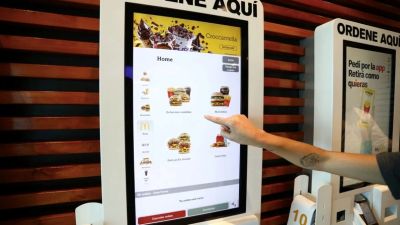
An example that made me reflect happened recently at a fast-food restaurant. In many establishments, you no longer order at the counter. Instead, we find touchscreens where we place our orders ourselves.
At first glance, it seems like simply a technological improvement: faster service, shorter lines, greater convenience. But there's more to it than that.
Various behavioral studies have shown that when no one is watching or listening to what we order, we tend to buy with fewer restrictions. We feel freer, less judged. And the result is surprising: we buy more.
Companies that implement these systems have observed that customers buy between 20% and 40% more when using these screens. For the consumer, it's convenience, and for the company, a significant increase in revenue.
There's nothing wrong with companies making money. Innovation requires investment, talent, and entrepreneurial risk. The problem arises when the benefits of progress are distributed increasingly unequally.
Many economists are already talking about a worrying trend: the progressive shrinking of the middle class.
Instead of a balanced society, we risk evolving toward a model with two large groups:
. A small, increasingly wealthy and powerful group.
. A growing majority with fewer resources and less influence.
Although articles and debates on this topic sometimes appear, the truth is that neither citizens nor governments seem to react strongly enough to this trend.
And the most curious thing is that we probably don't seem to want to. And the paradox may lie in our "technological toys."
Technology seduces us. It makes our lives easier, faster, and more entertaining. We love our phones, our apps, our video platforms, our online shopping, and our digital assistants.
And while we enjoy all these tools, we don't think about and readily accept the economic system that surrounds them.
Perhaps that is the great paradox of our time:
. We have never had so much technology and convenience.
. But it is also not so clear that the benefits of progress are being distributed equitably.
Perhaps it's worth continuing to ask ourselves this question from time to time. Because understanding how technology works in our society is the first step in deciding what kind of future we want to build.
And what do you think, my dear friend?
 EN
EN  ES
ES