
Views: 0
Some news stories run the risk of losing their impact simply through repetition. One such story is the fact that we break new temperature records every year. But perhaps we should pause for a moment and ask ourselves: how long will we continue to act as if this doesn't concern us?
The data from August 2026 is hard to ignore. According to Copernicus, it was the hottest month ever recorded, tied with July 2023. The global average temperature reached 16.96°C—about 1.65°C above pre-industrial levels. Furthermore, the summer of 2026 was the hottest on record in Western Europe.
A clarification is in order: exceeding the 1.5°C threshold for a single month does not mean the Paris Agreement goal has been legally breached. That limit refers to long-term global warming. However, the fact that a single month reached 1.65°C is undoubtedly another sign of the extent to which the planet is warming.
And the consequences are no longer abstract events destined to occur fifty years from now. Simon Stiell, Executive Secretary of the UN Framework Convention on Climate Change, recently warned the European Parliament that this summer's extreme heat caused tens of thousands of deaths in Europe, as well as damage to infrastructure, businesses, transport, and agricultural production. An estimate cited by Stiell places the economic cost of the extreme weather events in Europe that summer at around €180 billion, including productivity losses and disruptions to food, energy, and transport systems.
There is also a consequence that we can all easily grasp: the cost of our groceries. When heatwaves, droughts, or extreme rainfall reduce crop yields, production drops. If the costs of energy, transport, or water also rise, the impact is ultimately passed on to the consumer. You don’t need to be a climatologist to see it for yourself: you only have to keep an eye on food prices. And that is something I notice whenever I go grocery shopping.
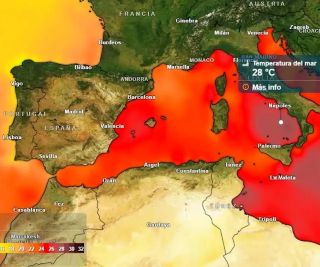
The Mediterranean is not immune to this process either. Exceptionally high surface temperatures were recorded this summer. In the Bay of Pollença (Mallorca), for instance, water temperatures exceeded 30°C and even reached 32°C—levels comparable to parts of the Caribbean.
A warmer Mediterranean does not necessarily mean there will be more storms, but it can supply more energy and moisture to specific weather events, potentially making certain extreme phenomena more intense.
The most worrying aspect is that this is not an isolated incident. Atmospheric and ocean warming continues. In August, the average ocean surface temperature outside polar regions also hit a record high for that month.
And here arises a question that should concern us all: climate change has no ideology. Heat does not ask who we vote for. Neither does drought. A flood makes no distinction between a left-leaning company and a right-leaning one. And when food prices rise, the cost affects us all.
That is why it is hard to understand how climate change has turned into a sort of partisan battle in some countries. We can debate the pace of the energy transition, its costs, the most suitable technologies, or how to share the burden. That is perfectly legitimate.
What is far harder to justify is ignoring the data. Adapting to a warmer planet will come at a cost. Reducing emissions does, too. Yet it is becoming increasingly clear that doing nothing is not free either—and that it will come at a very high price.
Perhaps that is precisely where we should focus the conversation: not on whether climate change exists—because it does—but on the cost of failing to take it seriously.
The thermometer is already speaking. Perhaps we should start listening.
 EN
 ES