
Views: 0
Autonomous driving has long promised to transform our relationship with the automobile. While we are still a long way off from a world where all cars can travel without human intervention, technology is advancing rapidly, and artificial intelligence is accelerating this process.
The car of the future will not only be able to drive for us; it could also come to understand *how* we want it to drive. Do we prefer a calm, smooth ride? Do we like to maintain a generous safety gap? Do we want a somewhat more dynamic driving style? AI is beginning to allow these preferences to be translated into parameters that the vehicle can interpret and adapt to. And this may be far more significant than it appears.
Modern automobiles are essentially computers on wheels. They control the engine, brakes, steering, lighting, safety systems, and a vast array of sensors. Added to this are cameras, radar, GPS, and—in some systems—LiDAR sensors capable of creating a three-dimensional representation of the surroundings.
Artificial intelligence is responsible for interpreting all this information. An autonomous vehicle needs to know its location, which vehicles are driving nearby, whether a pedestrian is about to cross, what traffic signs are present, and what might happen a few seconds down the line. It is an extraordinarily complex task.
That is why the most advanced autonomous driving systems remain expensive and are found primarily in high-end vehicles or specialized services, such as robotaxis.
Yet, autonomous driving is already arriving. We are not talking merely about laboratory experiments. In the United States, some robotaxi services have already logged hundreds of millions of fully autonomous kilometers with positive safety results.
The initial findings are intriguing. Recent studies have shown lower accident rates compared to human drivers in certain environments. This does not mean the technology is infallible, but it does demonstrate that autonomous driving can become a vital tool for improving safety.
What if we could tell the car how to drive? This appears to be one of the most interesting possibilities. Researchers are currently working on AI systems capable of adapting vehicle behavior to user preferences. There is even recent research into models that allow for the control of different driving styles based on parameters defined by the driver.
We could imagine a very simple conversation:
“I want a smooth ride,” “I’d prefer you to keep a greater safety distance,” “Take curves more gently,” etc.
Artificial intelligence could translate these instructions into concrete decisions regarding acceleration, braking, distance, or behavior in specific situations. And the possibilities are virtually limitless.
The user would never be able to order the vehicle to violate traffic laws or engage in dangerous behavior. The AI would need to establish a very clear boundary between personalization and safety.
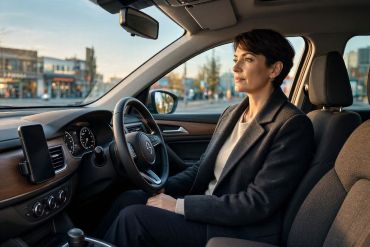
Level 3 could represent a major intermediate step. Fully autonomous driving—where the vehicle operates with virtually no human intervention—presents enormous technical, and above all, legal and economic challenges.
That is why I believe Level 3 could become a particularly important stage for drivers. At this level, the system can take over driving duties under specific circumstances and for set periods. However, when the system can no longer continue, it must prompt the driver to retake control, and the driver remains responsible for whatever happens.
Certified Level 3 systems already exist. Mercedes-Benz, for instance, secured authorization in Germany for its DRIVE PILOT system to operate at speeds of up to 95 km per hour under specific conditions.
This demonstrates that the technology has moved beyond the laboratory. But it also highlights something important: autonomous driving will not arrive all at once; it will be a gradual evolution.
The key issue is: Who is liable when something goes wrong? If a driver is in control of the vehicle while using a driver-assistance system, the human element remains a crucial factor in liability.
The immediate future likely won't bring a vehicle we can completely abandon while it ferries us from place to place. The transition will be more gradual: a car capable of driving itself at times, helping us avoid accidents, interpreting its surroundings, and adapting to our preferences—with AI acting as our permanent co-pilot.
Perhaps a time will come when, instead of asking whether the car can drive itself, the question becomes much simpler: "How do I want my car to drive today?" Technology appears to be moving in that direction.
First came driving assistants. Then came systems capable of handling specific tasks. Now, we are teaching artificial intelligence to understand our behavior.
And, as is so often the case with technology, features that today seem exclusive to the most sophisticated automobiles could eventually become standard equipment in mid-range cars—and, over time, in virtually all vehicles.
Autonomous driving still has a long way to go. But the journey has already begun.
Then there is the vast market for autonomous taxis, where the service provider assumes responsibility for the consequences of any accidents that might occur.
 EN
 ES