
Views: 5
Commercial aviation connects countries, boosts tourism, and facilitates global trade, but it also represents one of the most complex sectors to decarbonize. Unlike ground transportation, an aircraft needs to transport an enormous amount of energy with the least possible weight, making it especially difficult to replace fossil fuels.
With the goal of achieving net-zero emissions aviation by 2050, researchers, aircraft manufacturers, technology companies, universities, regulatory bodies, and government agencies are working together to develop new solutions. One of the main venues for presenting these advances is the H2-Aero Symposium, part of the AIAA Aviation Forum.
The fifth edition of the H2-Aero Symposium was held from June 8 to 12, 2026, in San Diego, California, bringing together some of the world's leading experts in sustainable aviation. During the meeting, projects, experimental results, and new developments related to hydrogen propulsion, cryogenic storage, airport infrastructure, and the future certifications necessary for these technologies to reach the market were presented. The forum confirmed that the transition to cleaner aviation is no longer a futuristic idea, but a technological race in full swing.
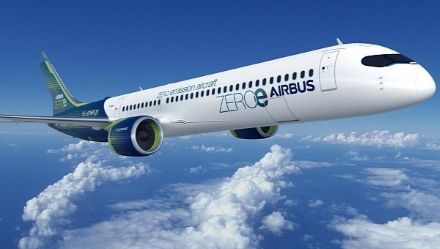
Hydrogen is one of the key players in this transformation. Its use is being studied through two different approaches. The first involves using fuel cells that generate electricity to power electric motors, a particularly interesting solution for regional and short-haul aircraft. The second focuses on modifying combustion engines to use liquid hydrogen as a direct fuel, an alternative designed for larger aircraft and long-haul flights.
However, the challenge is not simply about flying an aircraft powered by hydrogen. It is also necessary to resolve fundamental issues such as its storage at temperatures close to -253°C, the design of lighter and safer tanks, its distribution at airports, and the development of an infrastructure capable of supplying this fuel efficiently and competitively. These challenges occupied a significant portion of the symposium's technical sessions.
Advances are already becoming visible in regional aviation. Companies like ZeroAvia continue to conduct test flights with hydrogen fuel cell-based systems, aiming to launch the first commercial applications on select regional routes starting in 2027. Although there is still a long way to go before this technology is transferred to large commercial aircraft, the progress of recent years shows steady and increasingly robust development.
No one expects an immediate revolution. The history of aviation demonstrates that every major breakthrough requires decades of research, testing, certifications, and significant investment. But it also demonstrates that when there is a common goal, innovation ultimately finds a way.
Global demand for air transport continues to grow, and millions of people will continue to need to fly for decades to come. Therefore, developing technologies that drastically reduce emissions is not just a business opportunity; it is an environmental necessity and a shared responsibility.
Probably, in the first few years, traveling on planes powered by sustainable technologies will cost more than it does now. However, making that effort will be part of the price of preserving a more habitable planet for future generations. Because while continuing to fly may be necessary, doing so while polluting is becoming less so, and must cease to be.
Meetings like the H2-Aero Symposium demonstrate that the commitment exists and that international collaboration is accelerating a transformation that just a few years ago seemed distant. Perhaps we won't yet see large hydrogen-powered planes crossing oceans regularly, but each edition of the symposium brings that future a little closer.
Let's hope it arrives soon.
 EN
EN  ES
ES