
Views: 11
Decarbonizing aviation is one of the greatest technological challenges of our time. While electric cars are advancing rapidly, commercial aircraft still require fuels with enormous energy density. Therefore, every time a new solution emerges that can reduce air transport emissions, it generates enormous interest.
And that is precisely what is happening with the American company Twelve, which has just launched an industrial plant in Washington state capable of manufacturing synthetic aviation fuel (e-SAF) using only captured CO₂, water, and electricity from renewable sources.
At first glance, it seems too good to be true. Is it really possible to manufacture jet fuel from carbon dioxide present in the atmosphere or captured from industrial processes?
The answer is yes. The technology exists and is based on advanced electrochemical processes that use renewable electricity to transform CO₂ and water into chemical molecules that are then converted into aviation fuel. The result is a fuel called e-SAF (electronic Sustainable Aviation Fuel), chemically compatible with current engines and existing airport infrastructure.
The choice of Washington state also seems deliberate. This region has abundant hydroelectric power generation thanks to its large reservoirs, providing relatively inexpensive and stable renewable energy. And here lies one of the keys to the entire project: electricity is the main cost of the process.
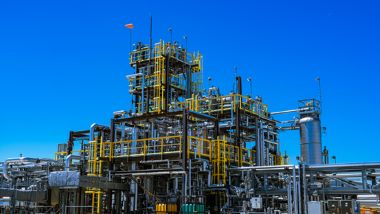
The photo below shows the manufacturing plant.
Until now, most SAF fuels have been produced from used oils, animal fats, or organic waste. While these solutions are positive, they have an obvious limitation: the availability of raw materials. The volume of fuel demanded by global aviation is so enormous that it is impossible to meet it solely with organic waste.
Therefore, the production of synthetic fuel from CO₂ is considered one of the most promising long-term alternatives. The necessary carbon could be obtained virtually without limit through industrial capture or even directly from the air, thus eliminating the problem of raw material scarcity.
In addition to aviation fuel, Twelve also produces e-naphtha, a raw material that can be used to manufacture plastics, packaging, solvents, and numerous chemicals that currently depend on petroleum.
However, significant questions remain. The first is economic. Although the technology works, the current price of e-SAF is still higher than that of conventional fuel. As with other energy technologies, the hope is that costs will decrease as production scales up and new facilities are developed.
The second challenge is production capacity. The Washington plant represents a technological milestone, but the aviation sector consumes hundreds of billions of liters of fuel every year. Many more facilities will need to be built for this solution to have a truly significant impact.
Even so, the project marks a very important step. For the first time, a commercial plant has demonstrated that it is possible to manufacture aviation fuel from CO₂, water, and renewable electricity on an industrial scale. Now begins the most interesting phase: verifying whether the technical and economic results meet the high expectations generated.
The AirPlant One plant, located in Moses Lake, Washington, began commercial operations in June 2026 and is producing E-Jet and e-naphtha fuel from CO₂, water, and renewable electricity, becoming one of the first commercial facilities of its kind in the United States.
Perhaps it is still too early to speak of a revolution, but initiatives like Twelve's bring us closer to a future where flying generates far fewer emissions without needing to change the aircraft we already know.
We will closely follow what the future holds for us in order to achieve a more sustainable environment.
 EN
EN  ES
ES