
Views: 1
The war in Ukraine is teaching a lesson that will likely shape military strategy for decades: drones have changed the battlefield. And what's most curious is that now it's the Ukrainian military that's teaching some of its European and North American counterparts how to fight in a scenario dominated by these small devices.
A prime example occurred in Germany during the Combined Resolve military exercises. These maneuvers involved US forces and forces from other countries, including M1 Abrams tanks. The Ukrainian military used its real-world experience to test tactics based on reconnaissance drones, FPV systems, and electronic warfare.
According to a report published by The Wall Street Journal, Ukrainian operators managed to detect and simulate the destruction of numerous US vehicles and personnel. This was not, of course, a real battle: it was a simulation exercise. But the result was striking enough to raise an uncomfortable question: how should tanks be used in a war where virtually everything can be observed from the air?
The Ukrainian experience is invaluable because it doesn't come solely from simulators or military manuals. For over four years of war, its soldiers have learned, often at a terrible cost, how to locate, conceal, attack, and defend themselves against drones.
And the transformation doesn't only affect tanks. The battlefield has become much more transparent. A vehicle that remains in one place for too long, a concentration of soldiers, or even a seemingly hidden position can be detected by a drone in a matter of minutes.
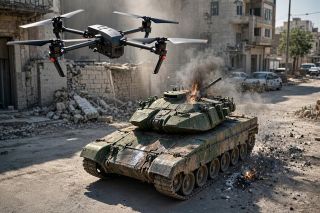
The figures help to understand the magnitude of the change. Estimates of Russian armored vehicle losses far exceed 14,000 units in some compilations based on visual evidence. For its part, Ukraine claims even higher figures for Russian losses, although these figures cannot be considered fully verified independently.
This doesn't mean tanks are no longer useful. Rather, it means they can no longer be used as before. They need protection from drones, infantry support, electronic warfare capabilities, camouflage, mobility, and much more precise coordination with other units.
The paradox is fascinating. The United States and several European countries have enormous technological resources, but Ukraine possesses something that cannot be easily bought: real combat experience against an adversary with considerable military capabilities. And that experience is beginning to change Western military doctrine.
Meanwhile, the war continues. February 2027 will mark five years since the full-scale invasion launched by Russia in February 2022; it will therefore be the fifth anniversary, not the beginning of the fifth year. Estimates of military casualties are extremely uncertain, but some research places Russian deaths in the hundreds of thousands and Ukrainian deaths also in very high numbers. The reality could be even worse.
And here comes the saddest part of this story. We are capable of quickly learning how to use a drone to destroy a tank. We learn to detect the enemy, improve our electronic systems, and design new weapons.
But we still haven't learned something far more important: how to prevent wars. Technology is advancing at an extraordinary pace. Humanity's capacity to resolve conflicts peacefully, unfortunately, seems to be progressing much more slowly.
 EN
EN  ES
ES