
Views: 87
Every summer we break new temperature records. However, the heat we feel in cities doesn't depend solely on the weather. A large part of the problem lies beneath our feet. Traditional asphalt absorbs nearly 90% of solar radiation, and when the air reaches 40°C, the surface of a road can easily exceed 60°C. The result is the well-known urban heat island effect, which turns streets and avenues into veritable heat accumulators, even at night.
That's why more and more researchers, engineers, and government agencies are opting for a solution that is as simple as it is innovative: developing roads and pavements that better reflect sunlight and accumulate less heat.
Far from being a futuristic idea, this technology is already being successfully tested in various locations. In Morocco, for example, light-colored pavements made with compacted gravel and other alternative materials to conventional asphalt are being used. In some cases, these surfaces are also permeable, allowing rainwater to infiltrate the subsoil. Subsequently, this moisture evaporates naturally, helping to cool the surface and the surrounding environment.
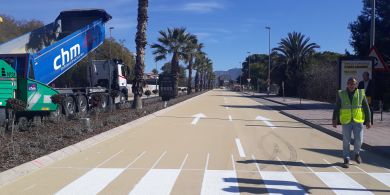
Spain has not been left behind either. One of the most interesting projects is LIFE HEATLAND, a European initiative that began in the Region of Murcia with the aim of reducing the urban heat island effect through highly reflective pavements. Its results have been very promising: measurements show a reduction of up to 2°C in ambient temperature and between 7 and 15°C in pavement temperature, in addition to a decrease in ambient noise and an improvement in nighttime lighting thanks to the increased reflectivity of the pavement. Following its success in Murcia, the project has also been implemented in Barcelona to test its effectiveness in another urban environment.
You can view the website at: https://heatlandlife.eu/category/life-heatland/
These solutions offer advantages that go far beyond thermal comfort. Cooler pavements reduce the need for air conditioning in nearby buildings, thus lowering energy consumption and greenhouse gas emissions. Furthermore, by reducing the surface temperature, their lifespan is also extended, as extreme heat accelerates the deterioration of conventional asphalt.
Experts agree that combating urban heat requires a combination of strategies: increasing green spaces, planting more trees, installing green roofs, creating shaded areas, and using urban materials that reflect solar radiation rather than absorbing it. New pavements are part of this set of solutions that cities will need to adapt to an increasingly warmer climate.
The most interesting aspect is that many of these measures do not require major construction projects or disproportionate investments. Often, it is enough to take advantage of routine street and road renovations to replace traditional materials with more climate-efficient alternatives.
The real challenge is no longer technological, but political and economic. The solutions exist, they work, and they have demonstrated measurable benefits. Now it is necessary to accelerate their implementation and provide them with sufficient institutional support so that they reach as many cities as possible.
In a context of increasingly higher temperatures, transforming our streets into spaces capable of cooling the environment is not only a matter of innovation, but also of public health, sustainability, and quality of life. Perhaps the future of cities begins, precisely, with the ground we walk on.
 EN
EN  ES
ES
Esquizofrenia: mientras plaudimos la lucha contra el asfalto negro, excelente iniciativa puesto que absorbe, según el articulo, alrededor del 90% de la energía solar que recibe (piénsese en los millones de kilómetros cuadrados que representan todas las autopistas y carreteras asfaltadas del planeta, además de los de las ciudades), aplaudimos también la instalación anual de mas millones de kms2 de placas solares fotovoltaicas, cuerpo negro prácticamente perfecto, que contribuye de forma acumulativa, probablemente mas que ningún otro factor individual al efecto invernadero global. Conviene recordar al respecto que de los gases comunes en la atmosfera es el vapor de agua el que mas efecto invernadero produce, contribuyendo los gases derivados de la combustión de derivados del carbono en un orden de magnitud inferior, siendo sin duda esa contribución muy importante a la hora de encontrar nuevos puntos de equilibrio de la atmosfera de la tierra.
Tienes una gran parte de razón. Tenemos por delante un reto muy difícil que interesa a muy poca gente, y al que se le aplican soluciones parciales. Pero sería peor no hacer nada. Un saludo