
Views: 20
For decades, we have seen robots capable of welding parts, moving heavy loads, or performing repetitive tasks with enormous precision. However, there is a challenge that continues to fascinate engineers and scientists worldwide: enabling robots to use their hands with the same natural dexterity as human beings.
And although we often don't think about it, our hands are true marvels of biological engineering. From childhood, we learn to grasp objects, turn them, squeeze with varying degrees of force, or manipulate extremely delicate items with hardly any conscious effort. We can hold an egg without breaking it, button a shirt, type on a keyboard, or pour water into a glass while automatically correcting every tiny movement.
All of this occurs thanks to an extraordinary combination of muscles, joints, and natural sensors. Human fingers possess enormous sensitivity to touch, pressure, temperature, and texture. Our brain receives information in real time and constantly adjusts the strength and position of the hand.
Replicating that capability in a robot is far more complex than it seems. For years, industrial robots have performed very well in controlled environments, carrying out repetitive tasks. But when it comes to handling fragile, soft, or irregular objects, the difficulties increase dramatically. Excessive pressure can break the object; insufficient force can cause it to fall.
This is where artificial intelligence is revolutionizing the sector. So-called "physical AI" allows robots to learn through practice and repetition. Just as a person improves a skill with experience, modern robots can analyze millions of movements, detect errors, and gradually optimize their actions.
A very interesting example can be seen in this video: https://www.youtube.com/watch?v=6K_bGH54ltI
It shows two robotic hands performing everyday tasks very similar to those of humans. They manipulate objects, rotate them, move them, and coordinate complex movements with considerable precision. Although they still move slowly, the progress is truly impressive.
The most important thing to understand is that speed is not usually the primary objective. Before accelerating their movements, robots must learn to avoid mistakes and prevent damage to the objects they manipulate. Once precision is mastered, the increase in speed comes relatively quickly thanks to machine learning and improvements in mechanical systems.
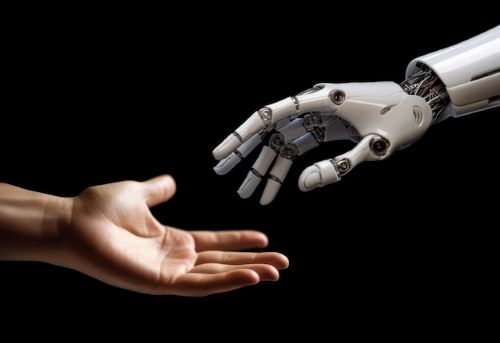
Furthermore, recent advances in tactile sensors are enabling the creation of "electronic skins" capable of detecting pressure, vibrations, or slippage with remarkable sensitivity. This brings robots ever closer to the human capacity to "feel" what they touch.
The future applications are vast. These systems could be used in hospitals, elderly care, advanced logistics, the food industry, or domestic tasks. They will also be fundamental for robots that interact with people in real-world environments.
We are experiencing a new era in robotics, where simply moving heavy objects or repeating programmed movements is no longer enough. The real challenge now is understanding and manipulating the physical world with delicacy, precision, and adaptability.
And along this path, artificial intelligence is becoming the driving force that will allow machines to learn skills that until recently seemed exclusively human.
 EN
EN  ES
ES