
Views: 23
For years, one of the most important tasks in recycling has been the recovery of materials at waste treatment plants. And also one of the hardest. Those who work in these facilities spend hours in front of a conveyor belt that never stops, separating plastics, metals, cardboard, and glass amidst noise, dust, and unpleasant smells.
It is a demanding, repetitive, and physically uncomfortable job. Furthermore, it requires constant attention to identify reusable materials that could re-enter the production chain. A small mistake can cause tons of recyclable waste to end up in a landfill.
It is not surprising that these types of positions have a high turnover rate, close to 40% in many recycling plants. And that is precisely where technology is beginning to change everything.
It is becoming increasingly common to find sorting robots working alongside Artificial Intelligence systems. Thanks to cameras, optical sensors, and advanced algorithms, these machines can recognize materials in real time and decide what should be recycled and what shouldn't.
Some robots function as robotic arms mounted on the conveyor belt. Others are mobile and work in different areas of the plant. They all share the same goal: to sort waste quickly, accurately, and continuously.
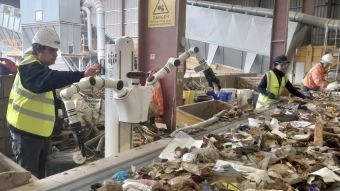
The great advantage is that robots don't get tired, they don't lose focus, and they can work for hours maintaining the same level of performance. In some modern facilities, they are already capable of identifying up to 80 objects per minute, multiplying the speed of manual sorting.
Furthermore, AI is constantly learning. Current systems use computer vision and machine learning to distinguish shapes, colors, textures, and even materials difficult for the human eye to detect.
Europe is already promoting highly advanced projects in this field. The RECLAIM project, for example, has developed portable recycling plants based on robotics and Artificial Intelligence, specifically designed for remote areas or places where building large infrastructures is not feasible.
All of this demonstrates something important: technology doesn't always destroy jobs in a negative way. In many cases, it replaces tasks that are particularly uncomfortable, dangerous, or undesirable. Automated waste recovery is a good example of this.
However, the underlying debate remains enormous. If more and more physical and repetitive jobs are performed by robots and intelligent systems, what will happen to people with less education or fewer technical skills? This is one of the great social challenges of the coming decades.
Automation will continue to grow, not only in recycling but also in warehousing, transportation, agriculture, urban cleaning, and industrial manufacturing. And although new technology-related professions will emerge, many people will struggle to adapt to an increasingly competitive and digitalized job market.
Therefore, in addition to developing more efficient robots, it will be essential to invest in training, professional retraining, and new job opportunities. Technology can improve our quality of life, but it will also force us to rethink how we want to organize work and the economy in the future.
Meanwhile, in many recycling plants around the world, robots have already begun to do a job that for years very few wanted to do.
 EN
EN  ES
ES