
Views: 17
Technology continues to forge new paths where progress once seemed impossible. One of the most interesting developments in applied robotics is the use of quadruped robots as guides for people with visual impairments.
The idea is not only to help them get around, but also to actively communicate with the user. And that completely changes the concept of assistance.
Quadruped robots—similar to a dog in their gait—have been used for years in industrial and research settings. A well-known example is the Spot robot, developed by Boston Dynamics.
Their main advantage is mobility. They can climb stairs, navigate obstacles, and adapt to uneven terrain, something very difficult for wheeled robots. These capabilities make them ideal candidates for moving around cities or complex interiors.
What is truly innovative is not just the movement, but the combination with artificial intelligence. These robots incorporate cameras and sensors that allow them to "see" their surroundings. But thanks to AI, they can also interpret that information: detect obstacles, recognize signs, and identify routes.
And here's the important leap: they can communicate all of this to the user through voice. They don't just obey commands, as a traditional device would. They can describe what's happening around them in real time.
Guide dogs have been an essential aid for decades. But they have clear limitations: they understand a limited number of instructions, they require years of training and communication is limited.
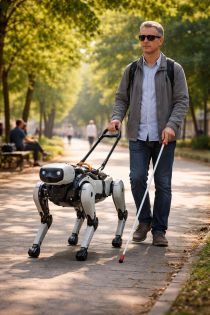
A robot, on the other hand, can be constantly updated. The knowledge acquired by one can be transferred to thousands of units almost immediately. This opens up a very powerful possibility: systems that improve globally over time.
These types of guide robots are still in the experimental phase. They are not ready for mass use, but the advances are promising. The fact that they can operate both outdoors and indoors makes them especially versatile. Furthermore, their communication capabilities can provide users with a much greater level of autonomy.
Beyond the technology, this development has a strong social component. Facilitating the mobility and independence of blind people is not just a technical improvement; it's a step forward in quality of life. And if these systems become affordable, they could be implemented in many cities around the world in a short time.
There are still significant challenges: cost, reliability, social acceptance, and regulation. But the direction seems clear. The combination of advanced robotics and artificial intelligence is creating new assistance tools that seemed like science fiction just a few years ago.
This type of robot won't completely replace guide dogs, but it can become a very valuable alternative or complement. For now, it's a development in the testing phase, but with enormous potential. And, without a doubt, it's an idea that deserves recognition.
A video can be seen at: https://www.youtube.com/watch?v=I7KIriqMbhI
 EN
EN  ES
ES