
Views: 0
Talk of automation, artificial intelligence, and robots capable of performing tasks previously done by humans is becoming increasingly common. One sector undergoing this transformation is goods delivery.
Major companies are seeking to cut costs and make their delivery operations more efficient. To achieve this, small delivery robots are beginning to occupy a space that until now seemed reserved exclusively for pedestrians: the sidewalk.
These are small electric vehicles, typically equipped with cameras, sensors, GPS, radar, and artificial intelligence systems. They can recognize obstacles, stop, adjust their path, and navigate autonomously to the customer's doorstep.
The technology is impressive. However, there is a difference between technology that works and the advisability of using it in our cities.
The main problem arises when these robots have to travel through spaces designed for walking. A sidewalk is not a road. It is a space intended primarily for people, and it must be accessible to children, the elderly, wheelchair users, the visually impaired, and those who simply wish to walk undisturbed.
What happens when numerous robots start moving through that same space? The potential problems are easy to imagine. A robot might stop, encounter an obstacle, cross paths with another robot, or need a pedestrian to step aside so it can continue its journey. If several are operating simultaneously, the situation can become even more complicated.
This raises a simple question: who should have priority on the sidewalk—the person walking or the machine making a commercial delivery?
There is also a privacy issue. These robots need to "see" what is happening around them. To do so, they use cameras and various sensors to navigate and detect obstacles. However, those cameras can capture images of people simply walking down the street.
And even though technology can implement systems to protect privacy, the concern is legitimate. Who stores these images? For how long? What are they used for? Who has access to them?
When a private company places numerous camera-equipped devices on the streets, society has the right to know clearly what information is being collected.
This expansion is not a distant prospect. It began in the US and China; in the UK, for instance, these robots are already operating in various cities while the government considers specific regulations.
Some operators have completed millions of deliveries, arguing that these systems can facilitate the distribution of food and small packages, reduce vehicle traffic, and provide a service that is particularly useful for certain individuals.
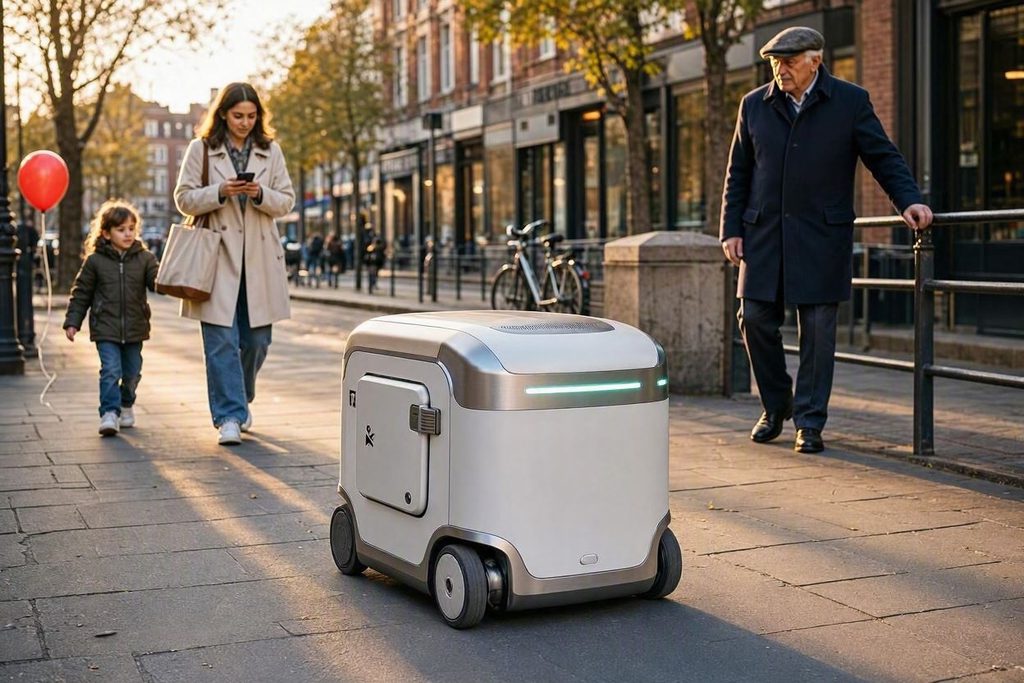
However, concerns regarding accessibility, safety, and the use of sidewalks have also arisen. Some cities in the United States and Canada have even restricted or banned their use following problematic experiences.
We must not overlook another aspect: when a technology triggers a negative public reaction, acts of vandalism against the robots may occur. Clearly, destroying or damaging them is never the solution. If there is discontent, it should be expressed through appropriate channels.
Must we accept every innovation? In my opinion, this is the fundamental question. Just because something is technically feasible does not mean we should use it everywhere.
Companies have the right to seek new ways of doing business. But cities belong to everyone, and public spaces should be designed with people in mind first. If achieving a slightly cheaper delivery means constantly sharing our sidewalks with machines, perhaps we should ask ourselves if we are saving money at the expense of our quality of life.
There are other possibilities: pickup points, smart lockers, small urban logistics hubs, or delivery systems that use roadways rather than pedestrian areas. Some of these solutions may well be more expensive. But perhaps that is precisely the price of living in cities that are comfortable, accessible, and designed for people.
Technology should help us live better, not force us to step aside to make way for it. Because if our streets are one day filled with robots, e-scooters, bicycles, and other devices, we will need to remember one simple fact: sidewalks were built for people to walk on. And perhaps we shouldn't turn them into a new highway for machines.
 EN
EN  ES
ES