
Views: 0
Robotics is entering a decisive phase. For decades, teaching a robot to perform human tasks has been a complex, rigid, and extremely expensive process. Today, however, a new paradigm is emerging: physical AI, an approach in which robots learn by directly observing people as they work, cook, assemble parts, or perform everyday tasks.
The idea is simple in concept but revolutionary in impact: if we want a robot to imitate a human being, we must first teach it how a human being behaves in the real world. And today, robots can learn by observing people.
To train these systems, relatively high-precision recordings of people performing real tasks are used. These recordings can be made with wearable cameras, often placed on the head, torso, or in the work environment, or even with a mobile phone attached to the head. Additional sensors can also be used to capture movements, objects, and context.
The goal is to feed artificial intelligence systems with raw, real-world data. Then, learning algorithms analyze these videos to understand patterns: how to grasp an object, how to arrange a table, or how to manipulate tools in a factory.
Once the behavior is learned, the model not only replicates it but can also adapt it to different conditions: a robot doesn't have human hands, the same strength, or the same range of motion. Therefore, AI must reinterpret human actions to translate them into its own "mechanical anatomy."
A relevant aspect of this new data economy is where many of these recordings are made. In countries like India, various companies have found a favorable environment for collecting large volumes of visual data, especially due to its low cost.
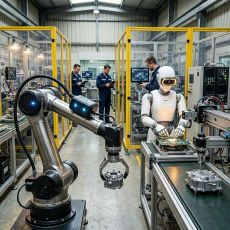
The main reason is economic: AI training requires enormous amounts of labeled and recorded video, and doing so in environments where labor costs are lower allows these projects to scale much more quickly. In some cases, it is estimated that an hour of recording can cost just a few dollars.
This has turned certain workers into “data generators” for global artificial intelligence. Their everyday actions—whether in factories, workshops, or domestic settings—are transformed into training material for robots that, in the future, could operate anywhere in the world.
This is a technological revolution with social implications, and this advance opens a profound debate. On the one hand, physical AI promises more useful robots, capable of assisting with dangerous, repetitive, or physically demanding tasks. It could improve productivity, reduce workplace accidents, and free people from mechanical work.
But it also raises an uncomfortable question: who really benefits from this technology? Large technology and manufacturing companies have access to massive amounts of data at low cost, allowing them to develop increasingly sophisticated and efficient systems. However, the workers who generate this data do not always share proportionally in the final profits.
This forces us to reflect on the concept of value in the age of artificial intelligence. If the knowledge that teaches robots comes from human labor, how should that value be redistributed?
How do technology, progress, and social justice intersect? Technological development is neither inherently positive nor negative. Its impact depends on how it is used. Physical AI can be an extraordinary tool for human progress, but it can also amplify existing inequalities if not managed properly.
It is not enough to lift people out of poverty. The real challenge is to guarantee decent living conditions, opportunities for development, and fair participation in the benefits of innovation.
In this context, ideas such as “data dignity” and fair compensation for human contributions to AI systems emerge. These are not fixed concepts, but they are signs that technology needs to be accompanied by profound ethical reflection.
The history of robotics and artificial intelligence is still being written. And its ultimate direction will depend not only on what machines are capable of doing, but also on the social decisions we make today.
 EN
EN  ES
ES