
Views: 7
Europe is changing. And it's changing much faster than we imagined just a few years ago. The automotive industry, one of the continent's major economic engines for decades, is facing a perfect storm: falling sales, fierce Chinese competition, high energy costs, and an accelerated transition to electric vehicles that not all brands are managing successfully.
In this context, many European companies are beginning to ask themselves a very simple question: how to survive in an increasingly complex market? The answer could lie, at least in part, in the Defense industry.
It's not a far-fetched idea. In fact, it's becoming a reality. Major German manufacturers like Volkswagen and Mercedes-Benz have already hinted at their interest in collaborating with military companies or participating in projects related to European security.
The reason is clear. While the European automotive sector is suffering, the arms industry is experiencing a boom driven by the new global geopolitical landscape.
And now Europe is feeling fear again. For more than 70 years, Europe lived under a relative sense of stability and security. US military protection seemed guaranteed, and many European countries progressively reduced their defense spending.
The world has long since changed. The Russian invasion of Ukraine has completely shattered that equilibrium. After more than four years of war, Europe has discovered something many preferred to ignore: peace is not guaranteed forever.
The threats from Russia are no longer perceived solely in Ukraine. Eastern European countries feel increasing pressure, and the fear of military escalation is now part of the continental political and economic debate. An atmosphere of distrust and fear has been created.
Furthermore, the relationship between Europe and the United States is no longer as strong as it once was. Donald Trump's statements questioning the US military commitment to Europe have set off alarm bells in Brussels and other major European capitals. And when a continent begins to seriously worry about its security, the defense industry automatically becomes a strategic sector.
And car factories have a lot to contribute. Here, a very interesting point arises: many of the industrial capabilities of automotive companies are perfectly suited for manufacturing military equipment.
Automotive brands already have a strong grasp of advanced industrial production, robotics and automation, complex vehicle design, metal fabrication and assembly, electronics and software, and large-scale logistics. They hold many cards.
Therefore, it is not surprising that some European executives are studying how to repurpose underutilized plants to produce military vehicles, drones, electronic components, or defense logistics systems. Volkswagen has already publicly acknowledged that it is exploring potential collaborations with defense companies to repurpose some of its German factories affected by the drop in production. And Mercedes has done something similar.
There has even been talk of projects related to air defense systems and adapted military vehicles. Although it may seem like something new, history has already witnessed similar situations.
During World War II, much of European and American industry was rapidly retooled to manufacture military equipment. Car companies switched to producing trucks, aircraft engines, armored vehicles, and weapons components.
When a society enters a period of geopolitical tension, the entire economy ends up adapting. And today, Europe is once again preparing for a scenario that seemed impossible just a decade ago.
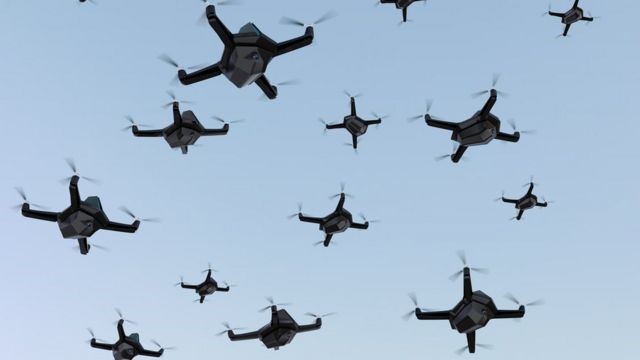
The war in Ukraine is also demonstrating something very important: modern conflicts are increasingly dependent on technology. Drones have become absolute protagonists on the battlefield. Thousands of units are constantly needed, in addition to sensors, electronic systems, secure communications, and specialized vehicles.
This is precisely where automotive companies could find new opportunities. The manufacture of drones or autonomous vehicles shares many technologies with modern automobiles: batteries, sensors, cameras, artificial intelligence, electric motors, and advanced software.
Europe needs to produce more military technology within its own borders and not depend on anyone external. And the automotive industry possesses much of the necessary technical expertise.
There's an old saying: "When you see your neighbor's beard being shaved, wet your own." That's exactly what many European companies are doing: analyzing the new world that's coming and trying to adapt before it's too late.
Because in such a rapidly changing global economy, those who react quickly survive. Those who don't, disappear. But I have to admit that it's deeply sad to see that in the 21st century, humanity continues to dedicate enormous resources to preparing for potential wars.
Perhaps the real problem is that, despite all our technological advances, we still learn far too little from our own history. What a shame!!
 EN
EN  ES
ES