
Views: 8
Just a few weeks ago, news from San Francisco caught the attention of the tech world: a company called Gatsby has begun offering a domestic cleaning service performed by humanoid robots. And we're not talking about traditional robot vacuums, but humanoid machines capable of entering an apartment, moving around, and performing cleaning tasks for several hours.
The proposal is as innovative as it is surprising. For a fixed price of $150, regardless of the apartment size, the client can book three hours of fully automated cleaning. The booking is made through an iPhone app, and at the agreed-upon time, a robot appears at the door ready to work.
The most striking aspect is that during that time, the robot remains alone inside the apartment. This is where many interesting questions arise. How is it verified that it does the job well? What information does the robot generate? Where and how is it stored? What happens to the client's privacy?
The most striking thing is that during that time, the robot remains alone inside the apartment. Household cleaning is an activity that has barely changed in over a hundred years. Yes, we've had advances like robotic vacuum cleaners, smart appliances, and more efficient products, but most of the work still relies almost entirely on people.
Now, someone has decided to take a much more ambitious leap: to completely automate the service using artificial intelligence and humanoid robots that understand their environment and adapt to it to perform their job.
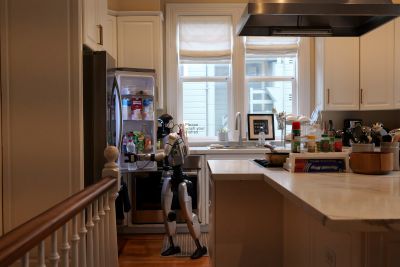
And the idea makes business sense. Instead of manufacturing a single, self-contained robot, the company adopts a model similar to Uber's: offering the service and using the available technology that works best at any given time. If more advanced robots appear in a few years, they will simply replace the machines while maintaining the same business model.
The big challenge is for a robot to act like a human. Although the proposal is fascinating, many technical questions remain. Current humanoid robots cost more than $20,000 (although prices continue to fall) and also have significant limitations. Cleaning a house is not simply a matter of vacuuming. A home is full of different objects, delicate surfaces, unexpected obstacles, and changing situations.
That's where artificial intelligence comes in. The real challenge is for the robot to be able to interpret its environment, make decisions, and manipulate objects precisely using its robotic hands. Folding a blanket, moving a chair, or picking up items from the floor are very complex tasks for a machine.
Domestic robotics is still far from perfect, but improvements in AI models and computer vision systems are significantly accelerating progress. Companies like Tesla Robotics, Figure AI, and Boston Dynamics are driving a new generation of robots capable of working in real-world environments.
The big question is privacy. To move and clean properly, these robots need cameras, sensors, and environmental recognition systems. In other words, they constantly observe what's happening inside the home.
The company claims to guarantee the security and privacy of its customers, but an important question remains: what information do the robots actually generate, who stores it, and what do they do with it?
Because if the system doesn't save data, it's difficult to verify that the job has been done correctly. But if it stores images or information about the home, we enter sensitive territory related to privacy and data protection.
This will likely be one of the most important technological debates of the coming years: to what extent are we willing to allow artificial intelligence to literally enter our homes?
It seems like a business with enormous potential. Despite all the doubts, the idea has enormous potential. The company already has a waiting list of clients, demonstrating the market's genuine interest in this type of solution. Furthermore, the price is competitive compared to many traditional cleaning companies in cities like San Francisco.
Of course, the beginnings won't be easy. There will be mistakes, technical limitations, and unexpected situations. Robots are still learning to navigate human spaces. But it's also true that all great technological revolutions began this way: with imperfect systems that seemed like futuristic curiosities and ended up transforming entire industries.
Gatsby has been one of the first companies to dare to turn humanoid robots into an everyday commercial service. And for that reason alone, it deserves attention. Time will tell if we are witnessing a mere technological novelty… or the birth of a new domestic industry.
I wish them all the best
You can see the company's website at: https://gatsby.bot/
 EN
EN  ES
ES