
Views: 20
For years, the laptop world has been dominated by two major players: Windows and macOS. But Google has just made its move, and it's far more ambitious than many expected.
This announcement has been in the air for some time. On May 12, 2026, during the Android Show: I/O Edition event, Google officially unveiled a new category of high-end laptop called Googlebook, which will run on Android and put Gemini's artificial intelligence at the heart of the entire experience.
This isn't a rumor or a leak. It's official, it's real, and it's coming this fall. The Googlebook effectively succeeds the Chromebook, although Google hasn't explicitly stated this. The company has confirmed that current Chromebook users will continue to receive updates according to their existing support commitments.
Chromebooks were a great idea for educational environments: inexpensive, connected, and easy to use. But the mainstream market needed something more powerful. More than 60% of the education market in the United States uses Chromebooks, and Google believes that segment will remain its natural habitat. The Googlebook targets a different type of user: one who demands more.
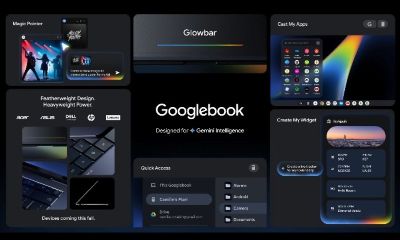
What's being presented is a new operating system, built from the ground up. The Googlebook isn't simply a rebranding or an evolved version of ChromeOS. It represents a fundamental pivot: from a conventional operating system to what Google calls an "intelligent system."
The new system combines the Android app ecosystem with the productivity and navigation architecture of ChromeOS in a single, intelligence-driven environment. The practical result is that the entire Google Play catalog will be natively available, something Chromebooks never quite achieved.
Gemini (Google's AI) is at the heart of the machine. The most striking feature is the Magic Pointer. Instead of simply pointing and clicking, moving the cursor will trigger contextual suggestions based on what's on the screen: point to a date in an email and Gemini suggests creating a meeting; Select two images and it will suggest combining them visually.
In addition, users can describe a custom widget in natural language and Gemini will automatically build it, connecting to apps like Gmail or Calendar to create a tailored dashboard.
One of its biggest selling points is its seamless mobile connectivity. You can use your mobile apps directly on the Googlebook without downloading them, and access your phone's files from the laptop's file explorer as if it were an integrated drive. For Android users, this completely changes the concept of a connected ecosystem.
Google presented the platform alongside five partner manufacturers: Acer, ASUS, Dell, HP, and Lenovo, although prices and specific technical specifications have not yet been announced.
This presents a great opportunity, with hundreds of millions of Windows computers losing security support after the end of Windows 10. The market is more open than ever to other alternatives. Google knows this, and the Googlebook is its answer: a modern, connected, powerful laptop with AI integrated into every corner of the system.
The first devices are expected to arrive in stores this fall of 2026. It won't be long before we see if Google can achieve what no one has managed to do so far: break the duopoly in the personal computer market.
The game has just begun.
 EN
EN  ES
ES