
Views: 3
The search for new sources of clean energy continues. While we on Earth continue installing solar panels and wind farms, some engineers are looking upwards and asking a logical question: why not capture the Sun's energy directly in space?
The idea isn't new, but until now the results have been limited. However, a recent proposal from the company Overview Energy has rekindled interest because it introduces a simple, different, and potentially viable approach.
In space, solar energy is available 24 hours a day, without clouds, without night, and without atmospheric losses. The challenge isn't capturing it, but transmitting it to the Earth's surface efficiently and safely.
So far, two main methods have been tested:
. Microwaves, with problems of dispersion and efficiency, and using an already saturated frequency spectrum.
. Lasers, with significant energy losses and safety risks.
Both approaches work in the lab, but scaling the system to commercial levels has proven complex and expensive. So far, it hasn't been deemed viable.
Overview Energy's idea breaks with these traditional approaches. Instead of microwaves or lasers, they propose transmitting energy using infrared waves, which can be captured by conventional solar panels already installed on Earth.
The proposal has several clear advantages:
. It doesn't require new, complex receivers on the ground.
. It leverages existing solar infrastructure.
. It reduces the complexity of the receiving system.
Essentially, the satellite would act as a "nighttime artificial sun," sending energy when there is no direct sunlight.
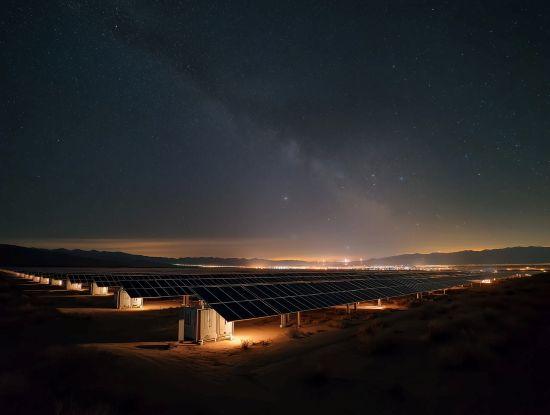
At the end of last year, Overview Energy conducted a significant first experimental test. Instead of a satellite, they used a Cessna aircraft flying at an altitude of approximately 5,000 meters.
From the aircraft, they transmitted infrared energy to solar panels already installed on the ground. The test was conducted at night, with low power levels, and yet the panels still managed to capture some of that energy.
This is the first known demonstration of this type of energy transmission. It's not a commercial solution yet, but it is clear proof that the concept works. And when an idea works, others begin to explore it.
The main drawback of this proposal is obvious: putting satellites into orbit is expensive. Space-based solar panels would have to be launched folded and deployed once in orbit, which increases the technical complexity.
However, once operational, a satellite would have a lifespan of many years, generating energy without fuel costs and with relatively low maintenance, beyond orbital management.
Furthermore, a satellite can easily redirect its signal, sending energy to different regions according to demand. In theory, it could power thousands of solar installations around the world at night.
It all depends on the numbers: launch cost, transmission efficiency, usable power delivered, and system lifespan. But the idea doesn't seem absurd, and that's saying something in a sector where impossible projects abound.
History shows that many technologies commonplace today—like communications satellites—began as expensive and experimental. But over time, innovation and increased production volume reduced costs.
The best ideas are often the simplest. Capturing constant solar energy in space and leveraging existing panels on Earth could be one of them.
If Overview Energy can demonstrate technical and economic viability, we could be looking at a new piece of the global energy puzzle. It won't replace terrestrial renewables, but it could complement them brilliantly.
Hopefully, they will move forward. In a world desperately in need of more clean energy, every good idea deserves a chance.
You can see the company's website at: https://www.ovwerviewenergy.com/
You can see a video of the energy transmission test from an airplane to ground-based panels at the end of: https://www.overviewenergy.com/updates/airborne
 EN
EN  ES
ES