
Views: 0
The world of batteries is constantly evolving. New chemistries, new materials, different formats, stricter safety requirements, and increasingly complex control systems. Everything is changing rapidly, and not just in laboratories: it's also happening in industry and in the end products we use every day.
The result is clear. Despite batteries being at the heart of the energy transition, very few Western companies have managed to establish themselves in this sector, which is now clearly dominated by China. Last year alone, more than ten battery companies went bankrupt. The most striking case was Northvolt, after billions invested and enormous expectations created.
From the laboratory to the market: that's the major bottleneck. Most companies focus on finding the perfect chemistry: less polluting, with abundant materials, higher energy density, and lower cost. All of that is important, undoubtedly. But the real problem arises afterward.
Between a good idea in the lab and scalable industrial production, five, seven, or even ten years can pass. That period is lethal for many startups. Funding dries up, the market changes, new technologies emerge… and the company can't keep up.
Furthermore, batteries evolve at a different pace than the products that use them. A manufacturer of drones, power tools, or vehicles can design a product for a specific battery, only to discover a few years later that that battery no longer exists or has been replaced by an incompatible one.
Added to all this are geopolitical tensions. Lithium, cobalt, manganese, or nickel are not always available where they are needed. China has secured its supply and vertically integrated the entire chain: from the battery to the electric car, the drone, or the storage system.
For Western manufacturers, depending on external suppliers, with fluctuating prices and evolving technologies, is a constant risk.
In this context, the proposal of a company called Proper Voltage is particularly interesting. Its approach breaks with the traditional logic of the sector. Instead of focusing on a specific battery, they offer a different approach: a Battery Operating System (bOS), a system capable of managing batteries of different chemistries and voltages.
This system handles critical aspects such as safety, thermal behavior, and energy management, regardless of the type of battery connected. Essentially, it decouples the product from the battery.
And this can be a game-changer. For a manufacturer, this can be a watershed moment. Instead of redesigning a product every time a new battery appears, it could be adapted in months, not years. It would simply require adjusting the management system, without altering the core design of the device.
This provides flexibility, reduces industrial risks, and allows manufacturers to evolve at the pace of the market. It also benefits battery manufacturers, who can offer new solutions without requiring significant changes to the final products.
For the end user, the result is clear: more up-to-date products, faster time to market, and potentially lower prices.
Put this way, it seems ideal for any manufacturer that uses batteries in its products, which number in the thousands worldwide.
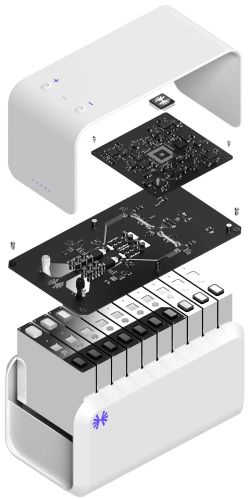
The photo above shows the chips and control electronics that manage the batteries.
Instead of relying on and adapting to batteries found on the market, this system would allow a manufacturer to manage the use of different batteries best suited to their products and evolve with new batteries as they appear on the market without having to redesign their products. And this evolution would take a few months instead of years.
Too good to be true? The idea sounds almost ideal, and as always in these cases, it's wise to be cautious. The key will be to verify if the system works reliably, safely, and on a large scale. For now, the proposal is coherent and addresses one of the major real problems in the sector.
A website of the company can be seen at: https://propervoltage.com/
Even with innovative ideas like this, dethroning Chinese dominance in batteries won't be easy. Their companies are deeply integrated and have a significant advantage. But solutions based on software, standardization, and intelligence may be one of the few realistic ways to regain ground.
Less obsession with perfect chemistry and more focus on how to manage change. Perhaps that's where real progress in battery use will begin.
 EN
EN  ES
ES