
Views: 2
Global trade moves by ship. Steel giants hundreds of meters long and tens of thousands of tons, loaded with thousands of containers, cross oceans incessantly. In such a sector, where a single mistake can have consequences costing millions and an enormous environmental impact, safety and reliability are not optional: they are essential.
For decades, navigation has evolved with new radars, improved electronic charts, and more precise positioning systems. But now comes an even bigger leap: the integration of artificial intelligence on the bridge.
One of the companies leading this change is UK-based Orca AI. Its solution, called Co-Captain, is already operating on more than 1,800 ships worldwide, a figure that shows this technological revolution is not a futuristic idea, but a reality unfolding at breakneck speed.
The name says it all. Co-Captain acts as an intelligent assistant that works hand in hand with the crew. It doesn't replace the captain, but it provides additional eyes and continuous analysis of what's happening around the ship.
To achieve this, the system combines:
. High-sensitivity cameras.
. Radar.
. Navigation data.
. Weather information.
. AIS signals from other vessels.
All this information is processed in real time and sent to the cloud, where the fleet using the system can share alerts, navigation patterns, and detected risks. In practice, it's a huge collective brain connected to ships sailing in similar areas.
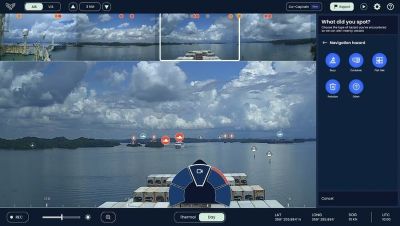
A cargo ship doesn't brake like a car. Nor does it maneuver quickly. That's why anticipating dangers is crucial. Co-Captain uses AI to detect: collision risks, small vessels that are difficult to see, rough seas, anomalous trajectories of nearby ships, etc.
The system issues clear visual alerts to the captain, who remains in control at all times, but with more reliable information and more time to react.
It's somewhat similar to GPS apps in cars that warn of traffic or obstacles… but on an infinitely larger scale and with a much higher level of complexity.
Maritime accidents are infrequent, but when they occur, losses can amount to hundreds of millions of euros. A simple delay of a megaship can trigger a domino effect in other ports.
That's why a system that improves safety, reduces risks, and optimizes routes is incredibly valuable. And given the price of a modern ship and the cargo it carries, I imagine the cost of installing Co-Captain is negligible compared to the operational benefits and peace of mind it provides.
Furthermore, the collected data is used to train models that are constantly improving, adapting to each maritime region and real-world sailing conditions.
Today, navigation is safer than ever, but there's still room for improvement. And AI can be a key tool for taking that extra step.
It's highly likely that within a few years, systems like Co-Captain will be present on almost every type of boat. And smaller boats will have similar systems with lower capacity and at a much lower cost.
Technology, sooner or later, always finds a way to seep through every crack. And at sea, one of those cracks is the opportunity to make navigation a little safer and a little smarter.
 EN
EN  ES
ES