
Views: 5
For decades, it has been rightly said that healthcare depends above all on people. Doctors, nurses, and technicians are the cornerstone of any healthcare system. But recognizing this central role doesn't mean ignoring an obvious reality: many tasks within hospitals can be done better, faster, and with fewer errors thanks to automation.
And that is exactly what is already happening, because hospitals are much more than just healthcare centers. A modern hospital is not just a place where patients are treated. It is an extremely complex organization, comparable to a large corporation. It manages thousands of people a day, enormous volumes of materials, critical technological equipment, maintenance systems, internal logistics, and constant flows of information.
In this context, introducing technology is not an option, it is a necessity. And automation is being deployed in two clearly differentiated areas:
. Robots and Technology at the Service of Medicine
The first major area is direct medical assistance, especially in surgery and diagnosis. Robot-assisted surgical systems allow for much more precise, less invasive procedures with shorter recovery times. The surgeon remains the decision-maker, but now has tools that expand their capabilities.
Furthermore, these technologies open the door to remote surgery, something unthinkable just a few years ago. Added to this are advanced diagnostic tools, supported by artificial intelligence, capable of analyzing medical images more quickly and detecting patterns that might go unnoticed by the human eye.
They don't replace the doctor; they complement them. And they do so by improving the quality of diagnosis and treatment.
. Logistics Robots: The greatly forgotten ones
The second area, less visible but equally important, is hospital logistics. In a hospital with approximately 1,500 beds, thousands of objects are moved every day: medications, clothing, instruments, samples, food, waste…
Traditionally, these tasks require a large number of people constantly moving around. Today, autonomous robots perform these routes continuously, precisely, and tirelessly, connecting with elevators, automatic doors, and central management systems.
The result is a clear improvement in internal efficiency and, more importantly, frees up healthcare staff time so they can dedicate themselves to what truly adds value: caring for patients.
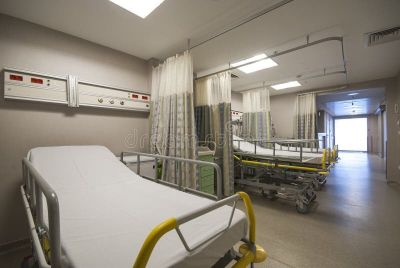
These are increasingly sophisticated technologies designed to help people do their jobs better.
This is a key point that is often misunderstood. It's not about machines taking care of the sick, but rather about them helping doctors, nurses, assistants, and other staff work under better conditions.
If a nurse receives medication on time, if equipment is well-maintained, and if supplies arrive where they need to without delay, their work is more effective and less stressful. The same is true for doctors, who need reliable and operational tools when they need them.
Artificial intelligence, which we already use daily on our mobile phones, is also present in hospitals: it optimizes schedules, manages patient flow, anticipates needs, and reduces administrative errors.
This coexistence will become increasingly normal. Seeing robots cleaning subway stations no longer surprises anyone. Seeing them in hospitals will be just as commonplace very soon. Cleaning, delivery, and logistical support robots will coexist with patients and professionals as part of the everyday landscape.
This generates concern for some people, especially regarding the impact on employment. It's a legitimate concern. But history shows that technology eliminates some work and transforms other work. New roles, new needs, and new ways of working emerge.
Automation in healthcare is not a fad; it's a logical evolution. Resisting it is a battle lost from the start. The key is to integrate it with common sense, always putting people at the center and using technology for what it is: a tool to live and care better.
 EN
EN  ES
ES