
Views: 0
When one observes the evolution of electric cars, renewable energy, or new industrial technologies, the contrast between China and the United States is striking. While China is accelerating on all fronts, the United States seems to be moving forward with the handbrake on, relying on an energy future that doesn't yet exist. And the question arises naturally: how is it possible that the world's largest economy is losing ground in key sectors of the 21st century?
The figures speak for themselves. China is a world leader in solar energy, wind energy, batteries, electric cars, high-speed trains, etc. This isn't a bet on the future: it's a present reality. In contrast, the United States maintains inconsistent policies that hinder the expansion of these technologies, as if they haven't quite accepted where the world is headed.
The climate is already changing, and its effects are visible every year: droughts, fires, floods, economic losses, and population displacements. The energy transition is not an ideological whim: it is a necessity, a matter of survival and industrial competitiveness. And yet, the United States acts as if it has infinite time, while China continues to widen its technological lead.
What is most surprising is that these technologies are already cheaper than their fossil fuel alternatives. Solar and wind power have reached record low prices, and batteries are decreasing in cost at a rate few imagined ten years ago. In a very short time, electric cars will be as cheap as, or even cheaper than, combustion engine cars, and they already outsell gasoline cars in several Asian and European countries. And who is leading this production? China, which manufactures more electric vehicles than the rest of the world combined.
Despite all this, part of the United States is almost blindly betting on fusion energy as a "magic bullet." A promising technology, yes, but one that, according to most experts, is still decades away from becoming a stable and cost-effective source. Believing that fusion will solve all energy problems in the short term is risky. And meanwhile, China is advancing with real, proven, and scalable technologies.
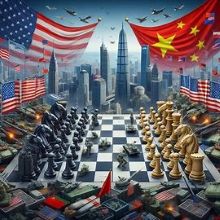
What we are witnessing is not just a trade dispute. It is a race to control the energy and technological foundation of the future. Cheap, renewable electricity will be the backbone of the global economy. Batteries will be one of the planet's most strategic resources. And electric mobility will be as commonplace an industry standard as the combustion engine is today.
Today, the automotive industry is one of the most important in terms of wealth and job creation, and it seems we have left the electric future in the hands of the Chinese. They are the clear leaders, and they continue to widen the gap.
Some countries have already grasped this. Others (including the USA) seem to be looking the other way, trusting that "there will be time" or that "something will come along" to maintain their lead. But the history of technology is clear: whoever starts first and scales fastest usually wins the market.
The world is changing at breakneck speed. Some are racing to get ahead, while others rely on their past. The question is unavoidable:
Do they simply refuse to accept the obvious? Or do they see something that others don't?
 EN
EN  ES
ES