
Views: 0
For years, road freight transport has been considered the last bastion of the combustion engine. Decarbonizing trucks, those diesel-guzzling giants that drive the global economy, was seen as a titanic, if not impossible, task. But, as is often the case, while the rest of the world debates, China is simply doing it.
The news is surprising and a turning point: in the Asian giant, diesel trucks are giving way to their electric counterparts at an astonishing rate.
Just five years ago, the fleet of heavy and light trucks in China was almost 100% diesel, without exception. Today, the reality has changed dramatically. According to recent data, in the first half of 2025, more than 20% of new trucks sold in China were already electric.
This figure is just the beginning. Projections, driven by strong political will, indicate that electric trucks could represent nearly 60% of total sales by 2026. This is an energy transition in heavy transport that is unparalleled worldwide.
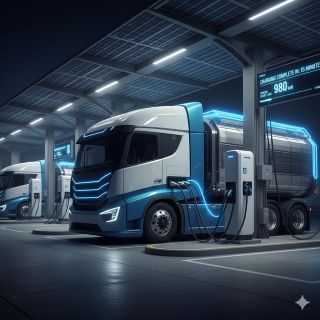
The Chinese Recipe: Subsidies, infrastructure, and determination. The secret to this breakthrough isn't magic, but a combination of government determination and infrastructure innovation:
. Direct financial support: Although an electric truck is initially more expensive (between two and three times the cost of a diesel), massive government subsidies are closing the price gap and accelerating fleet adoption.
. Ultra-fast charging infrastructure: The Chinese government is aggressively promoting the deployment of truck-optimized charging networks capable of replenishing energy in minutes, not hours.
. Battery innovation: Leading companies like CATL are not only improving battery energy density but also promoting battery swapping systems along major highways. A truck can pull in, swap its depleted battery for a fully charged one in the time it takes to refuel, and get back on the road.
Trucks consume approximately 30% of the fuel used on highways. This massive electrification has an undeniable environmental impact, bringing China closer to its emissions reduction targets.
But the benefit goes beyond the climate. By reducing diesel consumption, China drastically decreases its need to import oil, with estimated savings of around one million barrels per day. This translates into billions of dollars in foreign currency remaining in the country, strengthening its energy and economic security.
What China is demonstrating is that what was once considered "too difficult" or "far off" is, in reality, a matter of political will and strategic focus. They are taking the lead in a technology of the future, establishing a competitive advantage that will bring them significant global benefits.
Road transport can no longer be seen as the perennial weak link in the electric transition. Time will tell, but China's courage and determination have opened the door, and the rest of the world can either follow their example or risk falling seriously behind in this heavy-duty mobility revolution.
Those who fail to do so will be left behind, and regretting it later will be futile.
 EN
EN  ES
ES